
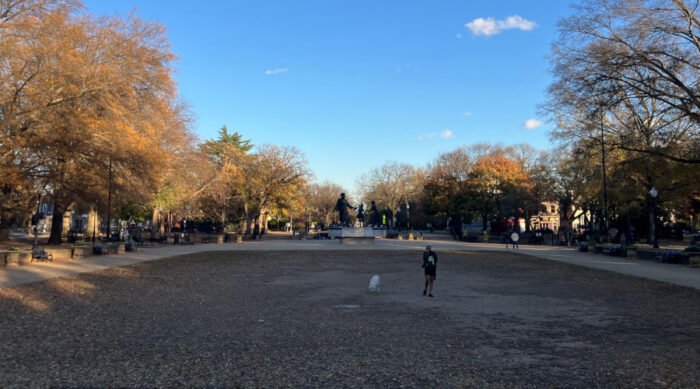
Lincoln Park is at the heart of Capitol Hill – not just geographically, but as a meeting point for runners, dog owners, and families. Its history could fill an entire book, and has been a subject I have gone back to many times over the years.
The story begins in the L’Enfant plan, where this reservation one mile east of the Capitol was saved for a milestone from which all distances to D.C. would be measured. The development patterns of the city kept this from happening, but also left a wide open space that could be used to a hospital during the Civil War.
Since there was no neighborhood or estate for which it could be named, so it was given the name of the President. In later years, the story grew up that it had been named not by some bureaucrat, but by the soldiers themselves.
The hospital was built – on purpose – far from the fighting. The closest it got to combat was when the Battle of Fort Stevens took places inside the District of Columbia. Some of those injured ended up at Lincoln Hospital.
The chapel of the hospital was also used as a school for ‘contrabands’ – freed enslaved people.
After the war, the hospital was torn down and the park was renamed for Lincoln. About ten years later, the Emancipation statue was added, and for the next quarter-century, Lincoln Park was the center of Emancipation Day celebrations in the District.
Throughout this time, the city grew around the park, and it was rebuilt a number of times as its use changed. In 1974, a second statue group was added to the park, honoring the educator Mary McLeod Bethune.