
Last week, I wrote about the first free school opened to freed slaves in the District of Columbia, and Hamilton Wilcox Pierson, who ran it. Today, we will look at another man whose life rivals Pierson’s in breadth, and the school he opened.
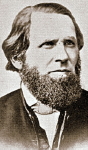
Right around the time when the first free school for freed slaves was opened on Capitol Hill, another school opened in the western part of the city. The school operated out of the basement of the Union Bethel Church on M Street, between 15th and 16th Streets NW. While the Reverend George L. Shearer was in charge, the actual teaching was done by Miss Elizabeth Smith, a young African American woman who worked at a private school nearby, and Lorenzo D. Johnson, a clerk in the 2nd auditor’s department. (That’s him at left)
Johnson, who originally hailed from Vermont, started as a minister in his father’s church, but when forced to give this up, became a writer, editor, and educator. His books were eclectic, to say the least. One book was about Roger Williams (whom Johnson counted as an ancestor); another was his mother’s memoirs. There was also a book “The Art of Memory,” purporting to be a scientific way of improving one’s memory. Apparently, this line of business was not particularly lucrative and so, in 1851, Johnson had gone into government service.
After the Battle of Bull Run, Johnson decided to help those who were injured in battle, at first at the front, then later in and around Washington. He was thus appointed a surgeon at Lincoln Hospital in 1863, and decided to open up a school there, as well. Finding a place for the school was not a problem – the chapel on the grounds of the hospital was an easy choice. He now needed a teacher, and again, he got lucky. In this case, Miss Laura Gates, of Pennsylvania, was available. She was the sister of the commander of a company of Veteran Reserves who were stationed there.
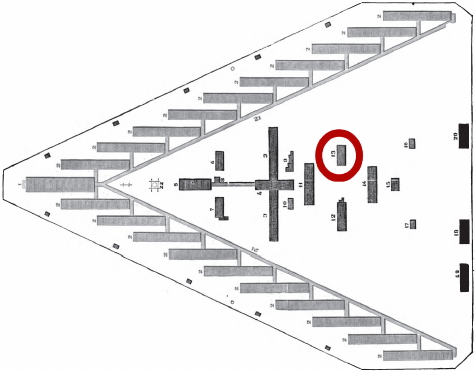
Her pay was not terribly munificent, being all of $20 a month. However, she was also given one ration at the hospital, so at least she did not have to forage for her own food. Her salary – at least at first – came out of the pocket of Dr. Johnson, though later he was able to get contributions from friends of his up north for her pay, as well as donations of clothing and books for those who were learning at his school
In total, about 50 of the contrabands who lived near the hospital, some of whom were presumably working there, were able to study at this school. All ages from 6 to 60 were students there.
The school remained in operation until the closing of the hospital, shortly after the end of hostilities. Dr. Johnson returned to the ministry, though not for long. He was hired by a Methodist Episcopal church in Massachusetts, and spent the next two years preaching there. He died in 1867, at age 61.