

While James Crutchett’s lighting of the Capitol had been mainly successful, there were still people who felt that he did not have what it took to expand beyond this fairly limited endeavor, and with the clamor for the expansion of gas lighting, both within the government and beyond, it was clear that others would have to take over the reins.
A group of citizens including Benjamin Brown French (that’s him at left) petitioned Congress to be allowed to form a company to expand on Crutchett’s work, and on July 8, 1848, President Polk put his signature under a bill that incorporated the Washington Gas Light company.
The men who in charge of the company had already done one crucial task: Buying out Crutchett. This meant that exactly three weeks after Polk had signed the incorporation bill, they sent their first bill to Congress requesting remittance for the gas provided from April 1 to July 31.
The next task of the company was to increase the gas supply. In order to do this, they bought land at 10th Street and Louisiana Avenue (today in the middle of Federal Triangle, just north of the Natural History Museum) where they built not just gasworks but their offices.
By the end of the year, they had laid numerous mains, erected lanterns and, most importantly, lit up the White House. Within 18 months of incorporation, they were paying their first dividend to their stockholders.
By 1852, they needed more capacity, and so built another gas works, this one just southwest of the Capitol at 3rd Street and Maryland Avenue. The Washington American Telegraph described the project on September 17, 1851:
The chimney, cannon-shaped and imposing, rises to the height of seventy-six feet, and is to be used more for draught than to carry off smoke, of which there will, we learn, be very little. The retort-house will contain fourteen benches, each with three retorts, in which the gas is manufactured, and will be a handsome edifice, with pressed brick front, heavy cornice, stone finishing, &c.; besides which there will be the purifying-house, meter-house, office, &c., &c., the whole forming quite a group of neat buildings, and will add very much to the life and business of that hitherto neglected portion of our city.
The annual report of the WGL that year echoed the Telegraph:
The new works have been completed and have been thoroughly tested, and are not only inviting to the eye but are believed to be unsurpassed by any similar works in the country.
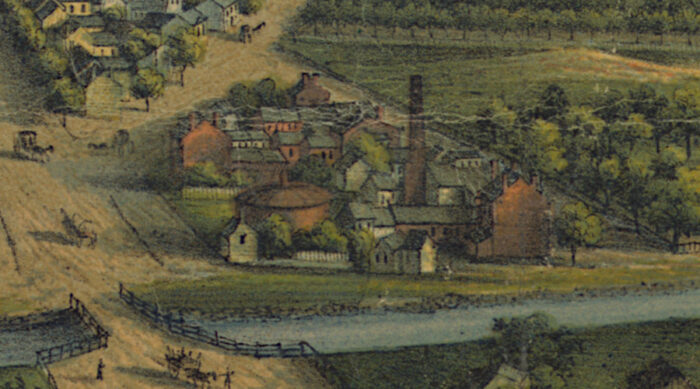
The only problem was that most of their customers lived further north, and had to pay their bills in person; getting to this office was not easy. In order to forestall complaints, a small office as opened at 8th Street and Pennsylvania Avenue where remittances could be paid.
Rapid expansion in the use of gas occurred hereafter, and only seven years later much larger gas works were built at 26th and G Streets Northwest. This location had the advantage of being close to the Potomac, making it much easier to bring in the raw material needed to make the gas.
As so often, there is no indication when the Maryland Avenue gas works were shuttered.