
Last week, we looked at the gas lantern that was installed above the dome of the Capitol. I turned out not to be what people had hoped, and, in fact, the whole idea of adding gas to the Capitol was questioned.
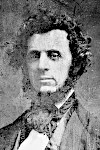
Senator George Wallace Jones of Iowa (to be seen at left) demanded that the Commissioner of Public Buildings Charles Douglas make a complete report on the damage done to the fabric of the Capitol during the installation of the gas lines, as well as determining if the dome itself was in danger due to the lantern, its pole and bracing wires.
Douglas’s report was certainly not what Crutchett’s proponents were hoping for. He wrote that any changes made to the walls were likely to a be a major problem, especially since much of the upper walls were in poor shape due to substandard building and settling even before any changes were made to them.
He was more cautiously optimistic about the lantern above the dome, stating that the engineering of it was sound, and should have no detrimental effect on the structure – as long as the weather remained calm. Any winds were likely to slowly weaken the dome over time. He continues
In high winds the pole acts as a great lever upon the parts to which it is fastened, and if it be true, that from its weakness, the dome is shaken by high winds, the wrenching and straining of this heavy oikes, at such times, must be injurious to it, and even endanger its stability.
He also mentions that the upper braces had already given way during a storm, so his worries appear well-founded. Furthermore, he felt that having one light to cover the entire grounds was hardly better than having multiple lights all around the grounds, especially given the “expense and great danger” of keeping the lantern in working order. Given that a worker had to climb a ladder above the dome to light the lantern, this seems to have been an understatement at best.
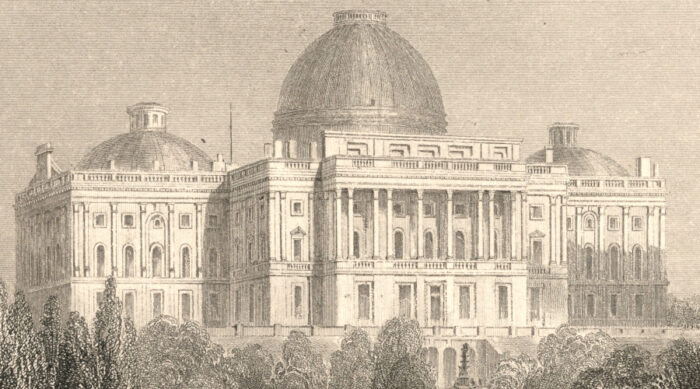
Finally, Douglas points out one final problem – that the lantern would be a great lightning conductor, it being made of iron and connected to an iron ladder and all intertwined with iron braces.
Judicious plans, I dare say, have been devised and carried into effect for conducting off from the dome the electric fluid, should the pole at any time be struck by lightning; but it is nevertheless possible that these plans may fail, and that the electric fluid may pass down the iron braces that sustain the bole, between the two wooden domes. Should such an accident happen, the consequences must be terrible, as the two domes most probably would be set on fire and consumed, to the great injury of the capitol, and possibly to the destruction of many valuable lives.
A few months later, the appropriations bill for the next fiscal year contained the brief paragraph:
For pay for removing the mast and lantern above the dome of the Capitol, three hundred and twenty-three dollars; and for the purchase and erection of lamps and lamp-posts of iron, and for the laying of gas pipes, and for other necessary fixtures for lighting the Capitol grounds with gas, to be expended under the direction of the Commissioner of Public Buildings, a sum not exceeding ten thousand dollars.
The newspapers seem to have taken no great notice of the removal of the mast and lantern.