
A while back I looked at a number of regiments of the United States Army that were briefly housed within the Capitol. As it turns out, this was not the only indignity this building suffered in this time. Since Congress had left the Capitol at the end of March, 1861, there was nobody there to keep the army from doing with the building as they wished.
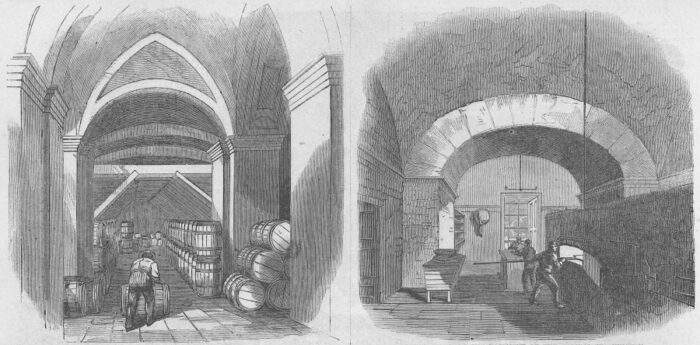
Thomas Walter, who had been the architect of the Capitol throughout its expansion in the 1850s, was one of the first to return in May of 1861. He wrote an appalled letter to his wife: “The smell is awful. The building is like one grand water closet – every hole and corner is defiled … the stench is so terrible I have refused to take my office into the building. It is sad to see the defacement of the building everywhere.” He even mentioned that the Senate chamber was “alive with lice.” Beyond that, Walter noted that most “of the passages in the building were filled up to the ceilings with barrels of flour, pork, beef, fish, crackers et al.” Finally, in order to put up the various groups of soldiers, temporary doors were fitted up throughout.
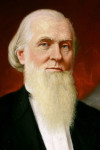
Some of the damage had been willful: for instance the attempted destruction of Jefferson Davis’s desk on the Senate floor, destruction of which had been stopped by the intervention of Senate Doorkeeper Isaac Bassett, who shouted at them that “You were put here to protect, and not to destroy!” (That’s Bassett and his magnificent beard, above) The soldiers, who believed that the desk belonged to Davis and not to the United States, desisted and that same desk – carefully repaired to show some of the damage done– is today used by the senior Senator from Mississippi.
Walter attempted to continue to finish his work on the Capitol – the dome was far from complete – but even he had to give up under the circumstances. Even the most committed cannot work with 100 drummers practicing right outside their offices. It did not help that most of the workers had disappeared, as well. He left Washington on May 30t.
When Congress returned in July 1861, there were other issues to be dealt with. While the local newspapers had downplayed the damage done to the building, it took quite a bit of work to get it ready for the members of Congress to continue their work, but, in the end, they managed. With this small piece of normalcy restored, Walter returned, as well. While his visit was short, he did manage to talk to Congressional and political leadership and set the path for him to continue work on the Capitol.
Chief among Walter’s – and Congress’s – complaints was the fact that the basement of the Capitol continued to be a large bakery. One of the activities that had been begun there was the baking of bread. Using the gas produced by the Washington Gas Light Company 170 workers ran the 20 ovens installed the basement around the clock, and were churning out 58,000 loaves of bread daily.
More on the damage done to the Capitol in this way next week.