

April, 1861 was a nerve-wracking time in Washington, D.C. While other states had already seceded, Virginia continued to dither, voting on April 4th not to join other southern states in leaving the Union, but leaving open the option to do so later. Eight days later, Fort Sumter was attacked and surrendered the following day. This encouraged President Lincoln to call up the state militias, precipitating Virginia’s vote to secede two days later.
This left the country’s capital in a most precarious position – right across the river from enemy territory. Fortunately, even before Lincoln had called for the militias, some units were already on the move. One of these was the New York 7th Militia Regiment (not to be confused with the 7th New York Infantry Regiment, formed nine days later) which had begun mustering a day before Lincoln’s request. The 7th Militia was also known as the “Silk stocking” regiment due to the many members of New York City society who joined.
The days following were confusing, to say the least. D.C. newspapers had multiple conflicting reports as to the status of the 7th. According to some, they had left on the day after Virginia’s secession vote, and were to arrive in the nation’s capital the following day – a perfectly reasonable assumption in that it was possible to leave New York at 7:00 AM every morning and arrive in D.C. by 6:00 PM. In fact, they did not leave until the afternoon of the 19th, and it took them almost a week to arrive. Washington was not entirely defenseless, however, as the 6th Massachusetts Militia arrived the day the 7th had left New York. The Massachusetts regiment had had to fight their way through secessionist mobs in Baltimore, so the 7th New York detoured by boat from Philadelphia to Annapolis to avoid similar confrontation, then march from Annapolis to Annapolis Junction, repairing tracks torn up by anti-Unionists as they went.
The Washington Evening Star of April 25 describes their arrival in the capital:
As the Seventh debarked from the train at the depot [just north of the Capitol] the Massachusetts Regiment station at the Capitol set up a shout that might have been heard a mile off; and immediately and immense crowd of people collected at all approaches to the Depot; and such a scene of shouting and excitement has certainly never before been witnessed here.
After about an hour, the 7th emerged from the depot and out onto Pennsylvania Avenue, headed northwest. Led by their band, they were welcomed by crowds along the sidewalks, on the roof-tops, balconies and windows lining the street. There as considerable shouting, bell-ringing and handkerchief-waving, as in the uncertain times before the regiment’s arrival, all sorts of rumors about how they had been set upon or even repulsed in Maryland had gone around.
Instead, they now marched to the White House in all their glory, where they were met by President Lincoln, Secretary of State Seward and Secretary of War Cameron, who came out on the portico to greet the newly-arrived defenders of the city.
The regiment then turned around and headed first to the hotels lining Pennsylvania Avenue for dinner, then to their quarters. Theodore Winthrop (that’s him, above) wrote up their approach for the July 1861 edition of the Atlantic Monthly:
We marched up the hill, and when the dust opened there was our Big Tent ready pitched.
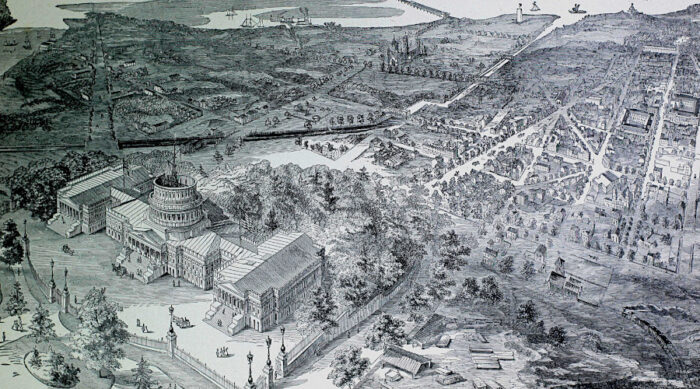
It was an enormous tent, – the Sibley pattern modified. A simple soul in our ranks looked up and said, – “Tent! Canvas! I don’t see it: that’s marble!” Whereupon a simpler soul informed us, – “Boys, that’s the Capitol.”
And so it was the Capitol, – as glad to see the New York Seventh Regiment as they to see it. The Capitol was to be our quarters, and I was pleased to notice that the top of the dome had been left off for ventilation.
Next week: Troops in the Capitol