
The last few weeks, I have been attempting to put names to those enslaved men whose work was crucial to building and running Capitol Hill. I want to end Black History Month by rectifying a mistake I have perpetuated in previous columns. As this mistake is name-based, it seems all the more relevant.
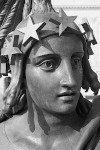
We go back to 1862 and the DC Emancipation Act, by which the some 3,000 enslaved men, women and children in the District of Columbia were freed. One of those freed was Philip Reid, who had, over the previous years, shown himself to be an invaluable member of the team in charge of casting the Statue of Freedom that was to be placed on top of the Capitol.
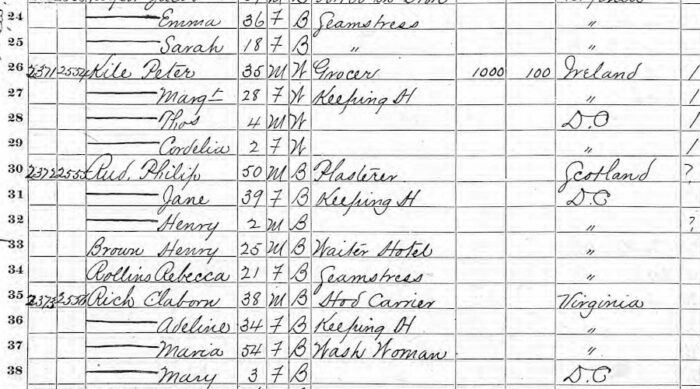
After emancipation, his story becomes difficult to follow, but Megan Smolenyak wrote an article in Ancestry Magazine based on what little information she was able to glean from the records of the time. It begins with a name change: All records post-emancipation have his name as Reed instead of Reid. This begins with his marriage to Jane Brown on June 3, 1862 – a month and half after his being freed. Already the Washington D.C. Marriage Records list him with his new name. It continues on in the 1870 census, where Philip and Jane Reed now have a son named Henry. Philip is listed as a plasterer, and in a book about the Capitol by Samuel Douglas Wyeth and published in 1869, the author states that he is “in business for himself.”
Philip Reed continues to be listed as a plasterer in the city directories throughout the 1870s, but something happens to Jane – and possibly Henry – in this time, as on January 21, 1879, Reed married Mary P. Marshall. In any case, only the newlyweds are listed in the 1880 census, he as a plasterer, she as a laundress. Throughout the 1880s, Reed is listed as living at 325 C Street SW, and continues to work as a plasterer.
The final entry to be found in the historic record for Philip Reed is his death certificate, which indicates that he died on February 6, 1892. He was buried in Graceland Cemetery two days later.
But his story does not quite end there. Two years after his death, the cemetery in which he was buried is closed, and the bodies moved. Reed’s body was moved to Harmonia Burial Grounds and Columbian Harmony Cemetery, also known as Harmony Cemetery. He would remain there until 1859, when this increasingly rundown cemetery – now the site of the Rhode Island Ave-Brentwood Metro station – was closed by the city of Washington, and its inhabitants scattered.
In Reed’s case, this meant a further move away from the Capitol that he had been so instrumental in building, ending up in Harmony Memorial Park Cemetery in Hyattsville, Maryland. In 2014, a memorial to Reed was unveiled there, though probably not on his actual grave. But it does list his name as the caster of the Statue of Freedom would have wanted it: Philip Reed.