
After looking at how enslaved people built the Capitol last week, I wanted to look a little further afield. For me this means, as so often, that I looked into the workers at the Washington Navy Yard. While the question of who worked there – free or otherwise – has been forgotten, there are a few documents that shed a little light on who worked there while enslaved, at least at one point in time.
The earliest is an 1806 document that lists all 148 civilian employees of the Washington Navy Yard. While no indication of the status of any of those listed is made, there exists a list of employees made two years later, 1808, that does have this information, and a number of names including Stephen Smoot, Rodger Howard and Tom King. appear on both lists. In other words, as early as 1806, enslaved labor was being used at the Navy Yard.
The aforementioned 1808 list was made by commandant Thomas Tingey after being told to reduce expenses. At the time, 179 men were employed at the Yard. While there was strong opposition to any reduction, Tingey did indeed fire some workers, as shown by two lists that indicated which Black workers were kept and which fired. Of those released, the vast majority were enslaved; the list of those retained was entirely enslaved.
However, these lists do not appear to be be a complete account of those employed, as other documents from the time list enslaved workers who show up on neither list, and, beyond their names, there is no further record of the men who were forced to work at the Navy Yard.
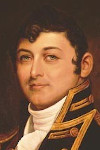
Isaac Hull (that’s him, above) took over the leadership of the Washington Navy Yard after Thomas Tingey’s death in 1829. The former Commandant had been there for many years, and the Navy Yard was in a state of change, so the Board of Navy Commissioners requested from Hull a listing of all those working at the Navy Yard. The report remains in the National Archives, and was retrieved and transcribed by John Sharp of Washington D.C. Genealogy Trails.
There are, in fact, two lists. One was a report submitted on May 8, 1829, and it contains a list of all those employed by the Navy Yard. The second list, sent on April 8, 1830, is specifically about Black workers, both free and enslaved, working at the yard.
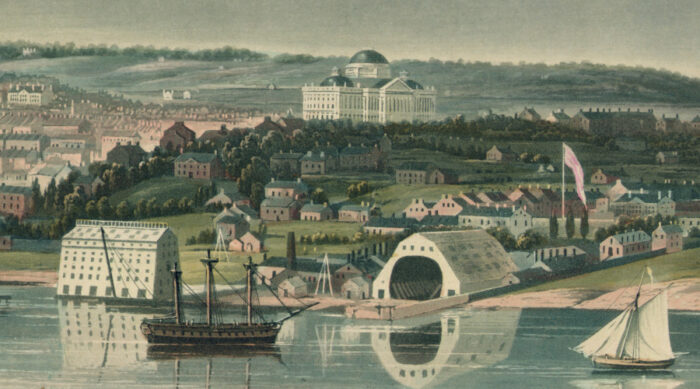
The first list shows that there are 188 workers who are paid by the day, and 13 who were paid by the month. A fair number of the hourly workers are listed as having been discharged. Therefore, the actual number of workers was certainly lower – and the number fluctuated by the season, anyway. There are eleven workers whose race and status is also included: Three men – George Carnes, who worked on the steam engine, Joseph Thompson and Walter Sommerville, who both worked in the anchor shop, were free Blacks. The other eight – Electus Davis, Charles Thompson, Moses Dyson, Alex Taylor, Leonard Taylor, William Brown, Frances Nallet, and Robert Gibson all worked on making anchors, and are listed as being enslaved.
The second list now shows 16 Black workers, seven of whom had been listed the previous year. Whether this fluctuation indicated great turmoil in the Yard over the previous year, or simply the normal ebb and flow of workers in the course of the year, or that the records were not terribly well kept is impossible to say now. While George Carnes remains at the steam engine, about half of the rest are working in the blacksmith shop, the others, including Michael Shiner, being “in ordinary.”
One thing is clear is that the first list is incomplete. There is no question that Michael Shiner was, indeed, working at the Navy Yard in April of 1829. He writes in his diary of greeting Hull when he took over the command, and describes the state that the grounds were in at the time.
Which is all to say that this snapshot of the state of workers at the Washington Navy Yard at that time is incomplete and, while it is nice to see some names for a change, there is still much that has been lost to history.