
This Black History Month, I want to go back and look at one of the earliest pieces of Black history on Capitol Hill – the use of enslaved labor to build the Capitol. The interest in this subject is relatively new – a 2005 report published by the Architect of the Capitol points to a 1991 book by Bob Arnebeck as the first attempt to grapple with this question, and in recent years, both Politifact and Snopes had to weigh in on the subject, indicating that there is still some disbelief that such labor was used to build what we perceive as a symbol of our country.
Before that, far more attention had been paid to those who had been in charge of the building: William Thornton, Benjamin Latrobe, and John Lenthal all come to mind. As to the actual workers and the sometimes terrible conditions under which they labored, nobody paid much attention to either. Additionally, no one seemed to mind that a not insignificant number of the workers had no say in where they would work or for whom, but received no compensation for the work they were forced to do.
Nonetheless, this information was always available. Deep in the National Archives are the records of the Office of Public Buildings and Public Parks of the National Capital, and in the ledgers and daybooks of the era from 1792 to 1802 are about four hundred entries related to labor paid to the enslavers. In almost every case, there is no indication of the person who did the work, only who received the money. These names are familiar to anyone who has looked at Washington history: Brent, Young, Thornton and Carroll.
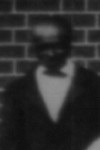
(Louis Brown, seen above, was enslaved by Carroll, though too young to have helped build the Capitol)
Slightly more informative are the records of the Commissioners of the City of Washington. Also held in the National Archives, here are vouchers, payrolls and promissory notes that kept track of the building – and payment for the building – of the Capitol. Here is a promissory note to Jasper M. Jackson, indicating that he was due for $15 for the work of his enslaved man “Negro Dick.” Or a $36 voucher to Joseph Turner for work done by “Ben & Alexander.”
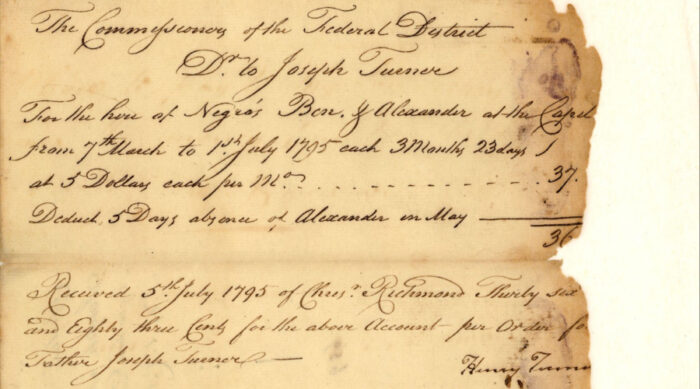
These receipts and records are still a far cry from expressing the full humanity of those who built the Capitol, but the collection represents a small step in the right direction.
Other letters and reports from the time indicate why such labor was so valuable, beyond the work that was done: Since the enslaved workers were not in charge of their own time, they could not strike for higher wages, which meant that other, free, laborers had to either acquiesce to lower wages or go entirely without.
Over the ensuing years, we have better records of enslaved men and women who were hired out to work on Capitol Hill: Michael Shiner, Henry and Sylvia Wilson, and Philip Reid are all names that have finally gotten their deserved due. While we will probably never have the full names and stories of those men who were forced to build the Capitol, at least there have been attempts to tell their story, including a memorial within the Capitol.