
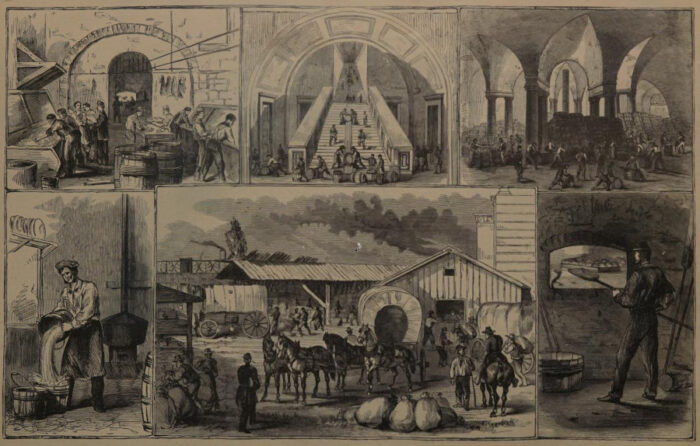
When Congress reconvened on July 1, 1861 in a radically changed city, the one thing that affected them most directly was the bakery that had been installed in the basement of the Capitol. On December 17th of that year the Senate sent a letter to Benjamin Brown French, the Commissioner of Public Buildings and Grounds, in which it told him to “inform the Senate of the nature and extent of the injury, if any, to the Capitol building and grounds.” They also wanted to know who had authorized this change, what it would cost for repairs, and if there was any pressing reason the bakery should be kept where it was.
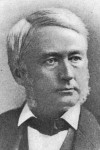
French began by writing to the Secretary of War, to determine who had authorized this. Thomas Scott, who signed himself “Acting Secretary of War” while only being Assistant Secretary and can be seen at left, answered by passing the buck to the Commissary of Subsistence Major Ames Beckwith, who in turn said that the occupation had been authorized by Lieutenant General Winfield Scott, who then had placed General Irwin McDowell in charge of these troops. Who here made the final decision was not clear.
Beckwith strongly rejected the idea of moving the ovens, as “the cost of erecting a bakery, with the appurtenances of the bakery at the Capitol, would be very great, and much time would necessarily be required to construct and perfect the masonry, to lay water and gas-pipes.” He closed by stating that by the time this was all completed, the troops would have advanced so far that there would be no need for any bakeries in the area.
French clearly did not agree. In his letter, he first quoted the librarian of Congress:
I am pained to see a treasure intrusted to my care – a treasure that money cannot replace – receiving great damage from the smoke and soot that penetrate everywhere through that part of the Capitol which is under my charge, without any means at my command to prevent it. I am now satisfied that there is no remedy, except in the removal of the circle of bakeries that hems us in, and of those directly under the library.
French then also quoted a “reliable source” – Richard Stewart, who was the General Superintendent of the Commission of Buildings and Grounds – who wrote that the damage done would cost about $7,800 to repair.
Furthermore, while Beckwith had claimed that there was no easy way to move the baking, French had the perfect place in mind – just west of the Capitol, the old gas-house, which would be “admirably adapted to the wants of the army as a bakery.” With two large buildings and a wide passage for wagons between them, as well as water and gas connections, it would only take a week to modify, and much of what had been installed in the Capitol could be reused.
Whether this move happened is unclear. It was not until July of 1862 that the Alexandria Gazette reported that the “army bakery, which was established in the Capitol in April, 1861, is now removing to a new building just erected near the Observatory.” The Naval Observatory was at the time near the Potomac past 23rd Street NW.
The Gazette also noted that in the time it had been active, the bakery had produced “ten millions seven hundred and seven thousand one hundred and fifty-one rations of excellent bread, for which 56,486 barrels of [flour]
were used.”