
It’s Public Domain Day. Again. (Well, that was on the 1st, but close enough) Once again, a slew of works are now in the public domain, so if you want to write A Shroom of One’s Own or A Farewell to Alms or The Malteser Falcon, have at it.
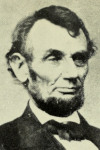
As always, I’m looking for a Capitol Hill connection, and I have to admit that the pickings were slim this year. A book-length look at Coxey’s Army was one option, but only a brief part of it takes place on the Hill. The other option was a book by Raymond Peckham Holden called Abraham Lincoln: The Politician and the Man.
Holden’s book is a look at Lincoln’s life, and it contains a particularly dour look at D.C. and Capitol Hill:
There has perhaps never been in the world a city enjoying renown as the seat of a national capital which has done less to repay with distinction, beauty, or any other quality the honor conferred upon it than the city of Washington, D.C., had done up the time of the Civil War. True, it was the one city in the country that had been laid out according to a carefully and well-drawn up plan, but in 1847 there was very little but mud and pigs to fill up many of the squares and circles which have since become as they were designed to be, the seat of garden plots and monuments, bronze, marble and living bloom. Most of the official boarding houses and other residences were clustered about Capitol Hill, where the unfinished seat of government squatted with its temporary wooden dome like a decapitated sphinx.
There is much to critique in Holden’s description, as colorful as it is: “very little but mud and pigs” certainly makes for an interesting mental image. However, Washington is far from the only city built “according to a carefully and well-drawn plan.” The good citizens of Philadelphia, for one, would strenuously object to this characterization. At least here, there is some room for discussion. (if you want another take, look no further)
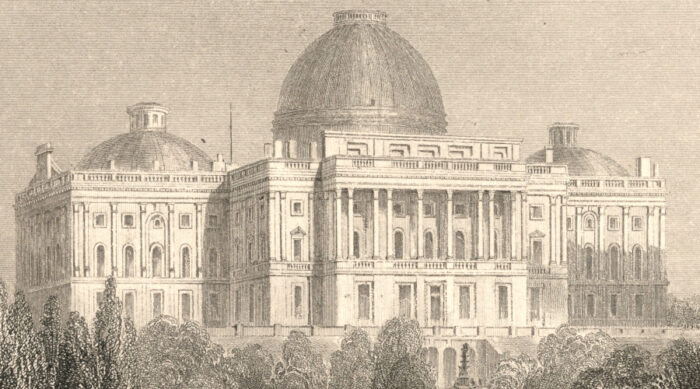
But to call the Capitol “unfinished,” with a “temporary wooden dome” is really pushing it. In 1847, the Capitol had been completed for some 20 years, and while there were still changes being made to it, and it was already becoming clear that it was getting too small, it fully conformed to William Thornton’s original plan, all the way to the copper covering over the dome.
Holden then continues his description with the arrival of the Lincolns in the city:
After the long and tiring trip, it must have been very terrifying to the simple middle-westerner and his uncertain-tempered wide and their four-year-old child to emerge from an uncomfortable train in a kind of ramshackle barn full of all sorts of unkempt and dirty loafers and to be confronted by a roaring, gesticulating, threatening horde of mad-hearted cab drivers.
Holden, who was mainly known for his poetry, began writing for the New Yorker in 1929, and continued to do so for the next 15 years. He would eventually move to New Hampshire and become involved in local politics. He would continue to write until his death in 1972.