
Over the last few weeks, we have looked at the New York Seventh’s arrival in D.C. and their stay in the Capitol. Their time in the Capitol did not last long. All they were waiting for was for their equipment, including tents, to be brought down from New York for them to have their own camp. The tents were set up just north of the city, on the grounds belonging to Dr. Robert King (who, coincidentally, was the grand-son of John Lenthall, famously killed in the building of the Capitol)
Theodore Winthrop describes the farm as being two miles north of the Willard Hotel. He uses this as a guidepost as “the hub of Washington.” The main house is used as the headquarters, and the tents housing the soldiers spread around it.
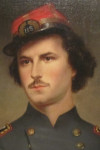
Meanwhile, back at the Capitol, another New York regiment had arrived: The 11th New York Infantry, led by Colonel Elmer E. Ellsworth, who can be seen above. They, too, were put up in the chamber of the House of Representatives. Better known as the Fire Zouaves, they were mainly drawn from New York City’s fire companies, and, during their time in the Capitol, they proved their worth when they fought a fire that threatened the Willard Hotel.
Like the 7th before them, the Fire Zouaves only spent nine days in the Capitol, moving across the Anacostia to the heights near St. Elizabeths, a move that Ellsworth mentioned in a letter had severely impacted their rations, and that they were reduced to beef steak, dry bread and coffee.
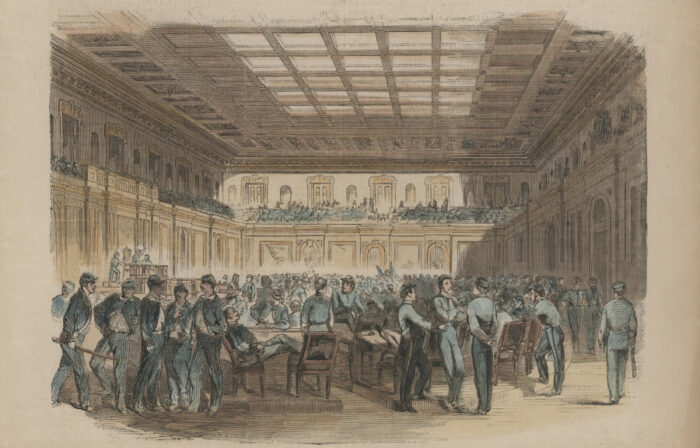
Meanwhile, back at the Capitol, the authorities were moving out all other troops, as Congress was to reconvene on the Fourth of July. An article in the Washington Evening Star of June 8t describes the work that needed to be done:
On the lower floor the long and spacious passages are almost completely blocked up with barrels of flour, leaving only sufficient space for two persons to pass abreast, consequently no cleaning has yet commenced in that portion of the building. But on the floor of the Senate and House, in the galleries, committee rooms, and adjoining passages, although but one “dose” of soap and sand has been applied, all grease, tobacco, and filth, which so much abounded a few days since, has completely disappeared, and another application will fully restore the rooms to their pristine neatness and beauty.
After mentioning that there was almost no damage in spite of the up to 7,000 men who had been quartered there, the writer gets to the specific:
The carpets have been taken up from the Senate and House floors, and busy hands are fast removing all indications of their late occupation. Taking into consideration the character of many who have tarried day after day in those halls, their condition is surprising. The white Italian marble of the Speaker’s desk is as pure and bright as when first polished, and the seats in the galleries show not a scratch or cut, notwithstanding the whittling propensities of the Yankee boys.
The article ends with the suggestion that “one or two more applications of water and soap and the work will be accomplished.”
And, indeed, on the prescribed day, both House and Senate went into session in their newly-scrubbed chambers.