
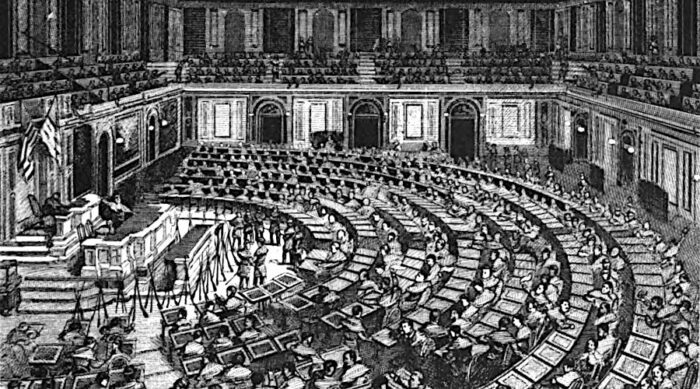
Last week we heard about the New York 7th Militia Regiment, from their mustering in New York, to their fraught trip south, their tumultuous greeting in Washington, and finally their march to their first accommodations: The Capitol. Theodore Winthrop described the scene in the Capitol in a piece published in the July edition of the Atlantic Monthly:
They gave us the Representatives Chamber for quarters. Without running the gauntlet of caucus primary and election, every one of us attained that sacred shrine.
Some men of the men of the 7th were taken up to the galleries, and installed on the sofas that were usually used by visitors to the House chamber. Most remained on the floor: “Each desk received its man. He was to scribble on it by day, and sleep under it by night. When the desks were all taken, the companies overflowed into the corners and into the lobbies.”
Winthrop continued to write about their situation, while sitting at the desks of John Covode (R-PA), John Cochrane (D-NY) and Anson Burlingame (R-NY)
Our presence here was the inevitable sequel of past events. We appeared with bayonets and bullets because of the bosh uttered on this floor; because of the bills – with treasonable stump-speeches in their bellies – passed here; because of the cowardice of the poltroons, the imbecility of the dodgers, and the arrogance of the bullies, who had here cooperated to blind and corrupt the minds of the people. Talk had made a miserable mess of it. The ultima ratio [The last resort, ie, force] was now appealed to.
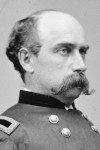
Egbert L. Viele, who was a Captain in the engineer corps of the regiment in this time and who can be seen above, would write about the accommodations in the July, 1885, edition of the Magazine of American History:
What a scene the Capitol now presented! At the entrance cannon loaded with grape and canister were planted. Arms were stacked in the Rotunda and sentinels guarded every avenue of approach. The whole building was one vast barracks. A bakery was improvised in the basement. Thousands of barrels of flour and other provisions filled the crypt. The marble floors resounded with the constant tread of the relief guard. Every available spot within the legislative halls, the galleries and the committee rooms, was appropriated for sleeping places, and the one great fact was now established beyond all peradventure that no flag but that of the Union could ever float over that great edifice.
While their purpose was extremely serious, there was also not much to be done other than frequent drills on the east front of the Capitol. The troops found ways to amuse themselves:
The monotony of daily life, if such a life could be called monotonous, was varied in numerous ways – among others were mock sessions of Congress, with all the gravity and, perhaps, more assumption of dignity than actual representatives. The proceedings would be conducted in regular order. A speaker would rap with his gavel and the House would come to order. Members from different sections would rise to debate. Innumerable and extraordinary points of order were raised, and constituted, as in more legitimate assemblages, the principal business of the House. It was a glorious field for the display of wit and humor, and was a never-ending source of amusement.
Next week: Moving on.