
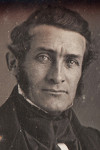
Lighting the Capitol was a problem from day one. Illumination technology was limited to candles and oil lamps, neither of which individually put out a huge amount of light. So in 1840, the House decided that what they needed was multiple lights all in one place to illuminate their chamber. They turned to Henry N. Hooper (see picture at left) of Boston for assistance.
Hooper devised and built an absolute monster of a chandelier. On September 5, 1840, the Boston Evening Transcript reported that this “beautiful specimen of yankee ingenuity” was completed, and would be hung up in Faneuil Hall as part of the Bunker Hill days so that all Bostonians could see for themselves. The Transcript continued:
It is one of the largest chandeliers ever made in this country, and reflects great credit on the manufacturers.
On October 31 of the Washington Native American described the new fixture more fully:
From its base, the chandelier rises in thirteen rows, emblematic of the thirteen original States. A the top of the outer, is thirteen faces, each containing two lamps. Above this is another row of lamps, making in all seventy-six. Above the lamps is the Coat-of-arms of the twenty-six States, as they entered the Union; and the whole is capped with the Eagle.
The whole thing was 19 feet tall and 13 in diameter, and weighed about 3,500 pounds (that would be an entire Prius today) and when the counter-weight added in made the whole system weigh some 7,500 pounds.
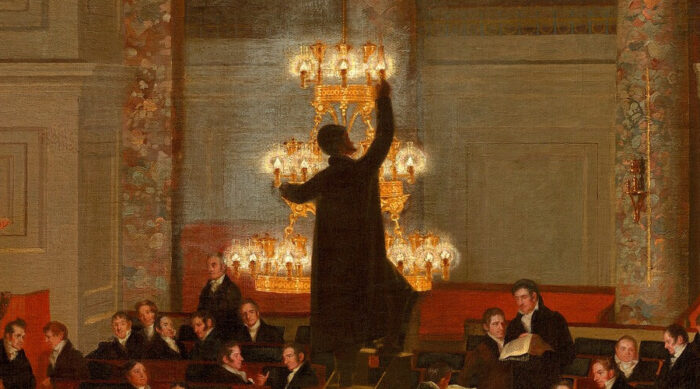
The chandelier had been lit for the first time on October 28. What the article does not mention – it probably being obvious to any reader at the time – was the source of light in the lamps of the chandelier. They would have burned the whale oil that was the preferred method for illumination at the time.
The chandelier only illuminated the House chamber for about six weeks. On December 18 of the same year, the whole thing came crashing down. The Washington Madisonian told the story the following day:
Yesterday morning, two attendants were engaged in cleansing it, and taking out the old oil, for the purpose of supplying the lamp with some of a superior quality. They suddenfly found the chandlier begin to ascend, and, in spite of their exertions – thyey throwing their weight upon it – it went of along the whole rod to the dome, and struck with great violence against the frame-work below the sky light; and instantly, the whole mass, chandelier, rod, fixtures and all, tumbled down.
Fortunately, the House was not in session, so nobody was hurt, only the two workers and Representative Patrick Goode, Whig from Ohio, getting the scare of their lives at that moment.
A closer look at what had happened showed that at the workers had removed enough weight from the chandelier that the counterweight dragged what was left up and into the ceiling.
There were no further attempts to put up a chandelier of this nature, and within the decade, gas was being installed for lighting in the Capitol.