
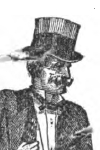
Is today a good day for another Beau Hickman story? Of course it is!
I have mentioned the “Prince of American Bummers” a few times in the past, and have gotten used to all the places where he shows up. But seeing him as a character in a play? That was new to me.
The play’s name is quite a mouthful: “The Tragedy of Abraham Lincoln or, The Rise and Fall of the Confederate States.” No author is given, though it is copyrighted by S. Whitaker Crowe, who is usually credited with having written it. Though, to be honest, it would not surprise me if he were not particularly keen on being connected with it.
The title page also claims that “This play was successfully performed in all the theaters of war throughout the United States during 1860, 1861, 1862, 1863, 1864, and 1865” which it claims is “seventeen hundred and seventy-six days and nights,” and is therefore “the longest Run of any Play on Record.” (There are 1,787 days between Lincoln’s being elected Republican candidate for President and Lee’s surrender at Appomattox, but why that number was selected is otherwise not stated.)
The play was published in New York in 1881, and should not be confused with another play with the same name published five years earlier in Glasgow. (In fact, it may have been written as a pastiche of the older play) There is also no indication that it was ever produced, and a quick glance through it makes it clear why, as it is as disjointed as it is ahistoric.
As to Hickman? Well, he appears a couple of times throughout the play to give some piece of exposition, usually with a distinctly southern spin to it. He appears in the first scene (with no introduction to the audience) during a street brawl between John S. Mosby (famous confederate soldier) Horace Greeley (northern abolitionist) and Franz Sigel (a German immigrant and general known for his ability to recruit pro-Union German immigrants to the US army.) Hickman’s first speech is to cheer on Mosby, but then after the arrival of noted surgeon and abolitionist Dr. Mary Walker, who calls for the police, Hickman adds “Cheese it, boys, cheese it, here comes the cop,” after which all exit.
The next time he appears, he is backed by a number of ragged soldiers who have presumably fled from the battlefield, and delivers these deathless lines:
Well, I’ll be cussed if I ever did see
Such a scared lot of Yankee renegades.
Why, not one month ago they marched this town
With colors flying and new uniforms,
Swearing they’d gobble up the Southern boys,
And bring Jeff Davis in a monkey’s cage.
Now here they go, all ragged and broke down,
Afraid to stop even when the get to town.
The third time Hickman appears is after General Grant’s victory in Vicksburg. This time, Lincoln actually gets in a response to Hickman before the latter exits, only to be replaced by none other than John Wilkes Booth, who hands Lincoln tickets to “Our American Cousin” at Ford’s Theater.
A few scenes later, Hickman joins a group of Union generals on Pennsylvania Avenue in front of the White House and declaims
Well, here they go again to tackle Lee.
I hope they’ll get into another panic
Before they get across the Rappohannock.
And that’s it for Hickman. The play lurches another two acts, never managing to get anywhere near coherence or historical accuracy. It is no wonder it never seems to have been produced, though if anybody ever does so, I will be happy to play the part of Hickman.