

As the Southeast Library renovation inches closer (no, we still do not have a firm date for its closure) the members of the Friends of Southeast Library are going through their files to see what is worth keeping, and what can safely be tossed. Hovering somewhere between these two are a stack of 10 self-published magazines that were published between April 1994 and January 1996 under the name “Street Stories.” The publication, which had, at various times, the subtitle “An Alternative Magazine,” “Washington’s Alternative Magazine,” and “The Real Washington D.C.,” was the brainchild of Bryce A. Suderow and Kenneth R. Kahn. While the former was a Capitol Hill resident who earned a small income researching and writing Civil War-related books ––some of which remain in print today–– the latter does not seem to have left much of a mark. (It does not help that his name is not exactly unique.)
The magazine devotes much of its space to the question of crime, which is, according to the co-editors, out of control. In the April 1994 edition (and the earliest in the collection from the Southeast Library) there are multiple articles entitled, “Is There Crime on Capitol Hill?” written by various Hill residents and workers. The answer is, for the record, unequivocally yes. There are also two articles entitled “I Don’t Feel Safe on 8th Street” and “I Don’t Feel Safe on Pennsylvania Avenue.” However, as far as Bryce and Kahn are concerned, the real problem is the police, and how they handle the population, especially those experiencing homelessness.
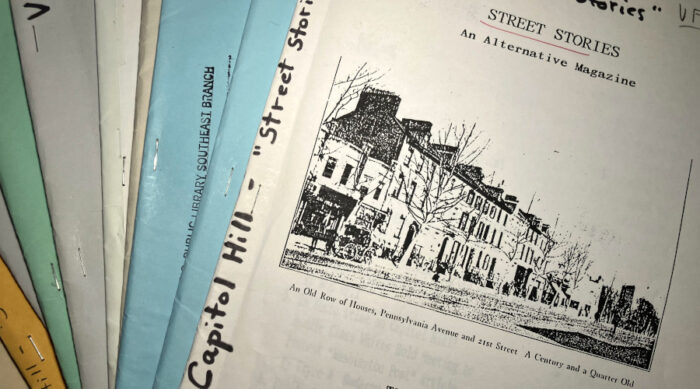
This is all in “Part I” of the magazine, which, according to a note on the first page, “consists of stories about Washington DC.” Part II starts off with condensed articles taken from the Washington Post and Washington Times, all of which are about Israel and the Palestinians. It then has an article about the “hidden history” of the Korean War. It then goes back to detailing the multiple failings of the DC police and the failure of the local press to hold them accountable.
Where the first section has some sort of coherence and at least attempts to present the reality of life on Capitol Hill during the terrible crime wave of the late 1980s and early to mid-90s, the obvious bias of the second section severely undermines whatever the co-editors were trying to accomplish.
It is no wonder that the few times that their names were mentioned in the mainstream press (a single article in the Washington Post and another in the City Paper) they do not come off well.
Either way, it is an interesting look at a pre-internet attempt at local journalism here on Capitol Hill, and something worth saving – possibly in the Washingtoniana collection of the DC Public Library.