

There are a number of characters who seem to appear, Zelig-like, during seemingly unrelated circumstances: Benjamin Butler, Montgomery Meigs, and Benjamin Brown French all come to mind. In these cases, it is hardly surprising, as all three had long and distinguished careers here in Washington. But sometimes, it’s a much less-well known person who appears multiple times in history.
So, for instance, is Thomas R. Gedney. Born in 1799, he was orphaned and then joined the US Navy as a very young man, just missing out on the War of 1812. Over the next 20 years, he worked his way up the ranks, and it was as a Lieutenant that he had his first brush with fame.
Gedney was on the east portico of the Capitol after attending the funeral of Warren R. Davis when President Jackson had two pistols pointed at him. Neither fired, in spite of the assailant’s best efforts. Gedney and one other (who, exactly, is uncertain–– very source gives a different name) wrestled the would-be assassin, Richard Lawrence, to the ground. Gedney’s quick action and the evidence he gave at Lawrence’s trial ensured that his name was found in newspapers all across the country. Soon enough, however, he was once again forgotten.
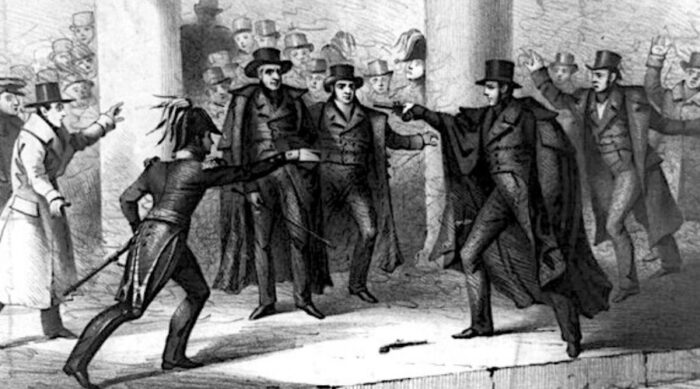
Six years later, Gedney found himself in the center of another important story––one that would resonate for many years.
Gedney had by now risen to the rank of Captain, and while still in the Navy, was put in charge of the US Revenue Cutter Washington. He and his ship came across the ship La Amistad, anchored off the coast of Long Island near Culloden Point. Gedney boarded it, and quickly determined that it was a slave ship whose unwilling passengers had overcome their captors and taken control.
Gedney impounded the ship, and then attempted to take it and its cargo – including the formerly enslaved people on board – for himself. The ensuing court case made its way all the way to the Supreme Court, where none other than ex-President John Quincy Adams argued that the fact that the slave trade was now illegal meant that these men could not be simply treated as cargo, to be parceled out to whoever demanded them. The court agreed with Adams, and Gedney had to content himself with getting the value of part of the ship and its non-human cargo.
Gedney stayed in the Navy, though letters from later in his career seem to indicate that he did not have an easy time of it, preferring the company of the rum bottle to anything else. He died at a relatively young age and was brought back to the site of his greatest triumph and his most profound defeat: Washington D.C., where he was laid to rest in Congressional Cemetery.
One hundred and forty years after his death, he was played by the English actor Ralph Brown in the movie Amistad, directed by Steven Spielberg.