
 When the Caldwell House, at 206 Pennsylvania Ave SE, was demolished in 1933 to make way for the John Adams building of the Library of Congress, it was the oldest private house on Capitol Hill, and one of the best examples of the Federal style of architecture to boot. However, today I want to write about the day that this house was almost lost, shortly after being built.
Elias Boudinot Caldwell was the son of a Revolutionary War hero and martyr. He lost both of his parents during that war. His mother was shot through the window of their home by a British soldier, while his father was murdered during the unsettled times between Cornwallis’s surrender and the eventual peace treaty. Caldwell was taken in and educated by his namesake, the Judge Elias Boudinot, and grew up to become the clerk of the Supreme Court in Washington, DC.
In 1809, Caldwell was in need of a home commensurate with his position, as well as appropriate for the guests that he was to entertain. A lot at the corner of B Street and Pennsylvania Avenue SE presented itself, and Caldwell had a grand, Federal-style building built on it. It was three stories tall, and 40 or so feet wide and was large enough to house his whole family, which eventually grew to include eight children.
Around the dining room table such luminaries as Daniel Webster, Henry Clay, and John C. Calhoun were frequent visitors, and when the Marquis de LaFayette visited the United States in 1824, he spent several days there.
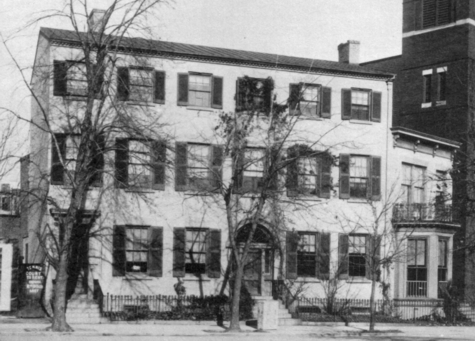
The Caldwell House ca. 1933 (Capitol Losses)
However, the most exciting moment in the house’s life came early on. During the War of 1812, Elias Caldwell was a Cavalry Captain at the Battle of Bladensburg. After the US forces had been ignominiously routed there, Caldwell fled back to the Capitol, where he removed the Supreme Court’s library from the Capitol building, storing it in his house two blocks away. Caldwell had, correctly, assumed that the British would be burning only public buildings, and that thus these important texts would remain unharmed. Caldwell had to leave his own personal library back in the Supreme Court chambers, as there was not enough time to rescue everything before the British soldiers arrived.
Dr. James Ewell, a neighbor, describes what happened next:
There was another case in which I had the satisfaction to save the property of a valuable citizen. As I was standing on the pavement near my door, which, as I said, the general and admiral had used as headquarters, a British officer observed in my presence, “Well, we shall be done with burning when the rope-walks are burnt and that handsome building yonder,” pointing at the house of my pious and worthy neighbor, Elias B. Caldwell, Esq.
“Why, certainly you are not going to burn that house, Captain,” said I. “Yes, sir,” replied he, “we shall.” “It is not public property,” I said. “No matter for that; there is public property at the house,” alluding to some cartridges and cartridge-boxes which had been left there; “and besides,” continued he, “it belongs to a man who has been very active against us.”
“It is true,” replied I, “Mr Caldwell is captain of a volunteer company and a brave man: but brave men do not bear malice against each other for doing their duty; on the contrary, respect them the more for it, as General Ross yesterday did Commodore Barney, and therefore I hope that as this house is private property it will not be destroyed.” He paused for a moment, then went to General Ross, who, I suppose, put a stop to it, for the house was not burnt.
For all its history, however, there was no last-minute pardon for the house when it was torn down in 1933, in order to make way for the new Adams building of the Library of Congress.
Do you know of any other pictures online of this house.
I searched all the usual places, but was unable to find a picture. The closest is a line drawing of the door on the Library of Congress website.