
Last week we looked at the death, burial, and ‘resurrection’ of A.C.H. Webster. George Christian, who had been responsible for the untimely removal of Webster’s body, was arrested a month and a half later, after having removed one Thomas Fletcher from Holmead’s Cemetery, located near what is today Dupont Circle.
He was hauled into court, where he was charged not just with Fletcher’s removal, but Webster’s as well. A number of people testified against him, starting with Thomas Thompson, who had been at the interment of Webster. His testimony was described later that day:
Went to cemetery yesterday morning and saw the grave opened. The lid of the coffin was split open and there was nothing in it, even the pillow on which the head was laid having been taken. Saw Christian at the cemetery where the body was found.
Others testified to having seen Christian there (presumably during the funeral) as well. Henry C. Volkman of the Georgetown police testified that he had found Christian’s diary, and taken that to the station.
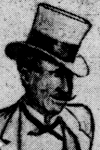
While the quote about Webster’s funeral and resurrection were damning in the present instance, the diary also indicated that Christian had been responsible for one of the more infamous exhumations – that of Beau Hickman, who can be seen above.
with the Chicago Daily Tribune quoting the diary:
Sept. 2 – Dr. – and I went out prospecting this evening, and succeeded in getting (characters in cipher, referring evidently to the body of Beau Hickman.) It was a lovely moonlight night, and everything went off smoothly.
The last phrase must have come as a surprise to Hickman’s friends, who found his grave to be in great disarray, with parts of the deceased scattered about.
The diary also revealed that Christian had managed to recover one body per night, earning a solid $15 dollars per successful foray.
The evidence was enough to convict Christian to a sentence of one year and a fine of $1,000 A few days later, the Army, for whom Christian worked, fired him.
Christian appealed his sentence, and so another trial, this time in front of a jury, took place the following January. The evidence presented was much the same as during the first trial, and in the end, it took only 15 minutes for the jury to reach a verdict of guilty on all charges.
Christian was, once again, sentenced to a year’s imprisonment.
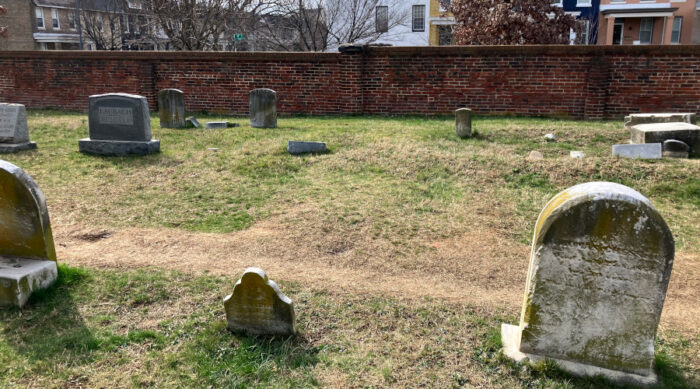
One final question was never answered: What was the final disposition of Webster’s body? While it is most likely that it ended up on the dissection table of some medical school, it never came out which one this might have been, leaving the grave of Webster in Congressional Cemetery empty – and without a headstone. The site is hard up against 17th Street – which is probably why it was of interest to Christian in the first place.