

Friend of the blog John DeFerrari recently posted an interesting picture on Twitter. It showed a couple of classic D.C. rowhouses with a family, including an older gentleman in a top hat, out front. The question asked was where this might be. While some were stumped, Matt Hankins (he’s @restocarp on Twitter) placed it on Seward Square. In fact, the houses still exist as 508 and 510 Seward Square.
This led to wondering who the family out front might be.
The picture was taken in the years between 1890, when the two houses were built, and 1908, when 512 Seward Square was built. The houses were built by John E. Herrell, long-time President of the National Capital Bank and other financial institutions. His daughter, Phoebe Cole, and her family lived in 510, and it may be a few of her children sitting in the doorway of the house on the right.
The family on the sidewalk is most likely their neighbors, Andrew and Florence Geddes and their children. Mr. Geddes had had quite a life before settling in the District: Born in Ontario, Canada in 1844, he had emigrated to Iowa as a young man. At the outbreak of the Civil War, he – and a number of his brothers – joined the Union Army. He was only 16 years old.
While Andrew was initially a Corporal, just five months later – and at just 17 years old – he was promoted to Lieutenant Colonel. Later records indicate that he commanded the regiment while the Colonel was not available. That’s him at the top of the post as a soldier.
At the battle of Shiloh, he, along with many others from his regiment, were captured. He was eventually exchanged for Confederate prisoners and re-joined his regiment, serving until May of 1866.
After his initial service, Geddes rejoined the regular army as a Lieutenant, and served for 13 years, eventually rising to the rank of Captain. He served in different posts all across the country.
Upon leaving the army, Geddes moved to Washington. His first job here was a clerk in the Pension Office, but in 1897, he was made Chief Clerk of the Agriculture Department. His qualifications for this post were, according the Washington Evening Star, that he had “the support of the Union Veteran League of the United States, and [was] a great favorite in G. A. R. Circles.”
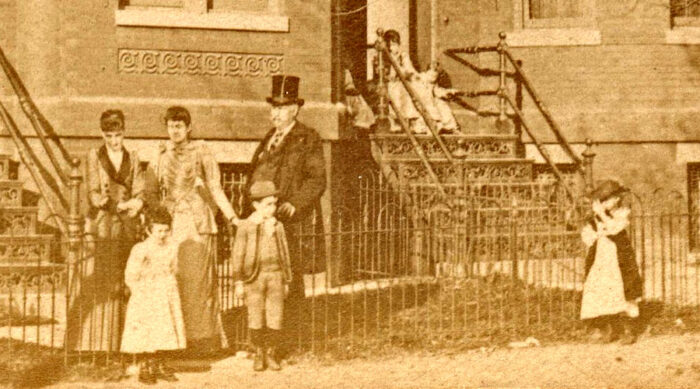
Around 1900, Geddes and his family, which consisted of a 16 year-old daughter plus three further children under the age of seven, moved to Seward Square. The picture shows a family matching this: Husband and wife, one teenage daughter, two younger daughters and a son.
By 1903, however, they had moved out to Kensington, Maryland. Geddes continued to be active in Civil War memorial ceremonies. His wife died in 1910, and was buried in Arlington Cemetery. The end of Geddes’s life is a bit uncertain. He is listed as having died in St. Elizabeths hospital, and his name had disappeared almost entirely from the newspapers in the years after his wife’s death, indicating a certain slide in his life’s fortunes. His obituary in the Washington Times was perfunctory at best. It was, without a doubt, a sad and quiet ending to a man who had epitomized a certain D.C. archetype of the late-19th Century.
Geddes was buried in Arlington Cemetery next to his wife. His gravestone lists not his rank during the Civil War, but rather the one he attained in the post-war Army: Captain.