

I am currently working on a short article on the history of Eastern Market, so I’ve gone through my notes from my talk last month to see which aspects of its stories I have not yet fully researched. One of the men involved in the market who deserved a deeper look was the contractor, Henry Wingate, but just as important is the man who made the market a success: Benjamin F. Graham.
Eastern Market seems to have done quite well from the outset, although there are few articles referencing it one way or the other in its early years. The only problem seems to have been an inability to hold onto a market manager for more than a few years. While George Fry, the first market manager, seems to have been quite well liked, his death in 1875 set off a series of managers who only served for a few years before moving (or being moved) on.
This would change in 1892 when Benjamin F. Graham was appointed market master. Graham had been born in Ohio, but raised in Warren County, Illinois, and would serve during the Civil War in two different Illinois regiments. He would return to Illinois and marry Lucy Brooks, with whom he would have three children over the next five years. After a stint in Iowa, in which a fourth child was born, the family moved to D.C. around 1890, where Benjamin joined the Capitol Police.
In early April, 1892, the current market master, Robert Lusby, resigned his position. He had been suffering from various diseases for some seven months at this point. His resignation was announced on April 4, and he died later that day. The Commissioners appointed Graham to fill his position.
Graham’s first few years were not easy. Less than a year after his appointment, the Panic of 1893 hurt the economy, including those renting spaces in the market. A year after taking over, Graham was asked by the commissioners why the rents had been paid consistently late for the last few months. Graham explained that he was having difficulties collecting rent, and that some months, he had to advance his own money to pay the bills. Another sign of the times came early the following year, where Graham and others ran a relief organization from the basement of the market, distributing soup and bread to some 500 people on one day.
That same year, Graham had to deal with another issue: A poultry dealer was selling problematic meat. The dealer had pulled a dead chicken from a barrel, plucked it and sold it as if it had been properly killed. The dealer was fined $20 for this, and Graham wanted him banned from the market permanently. The commissioners did not agree and overruled Graham.
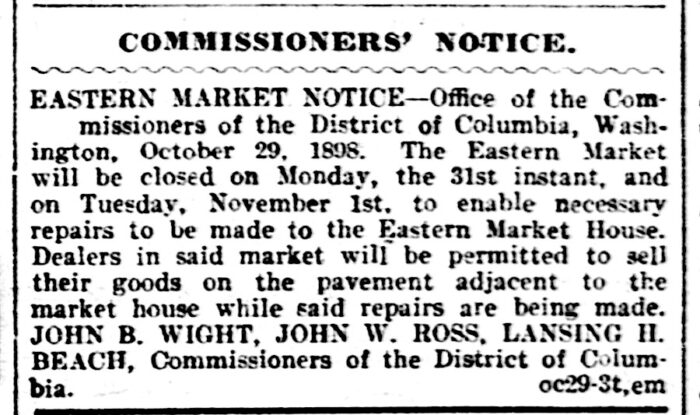
With the end of the recession, things started to look up in the market, and in 1898, Graham was able to make improvements to the market, in particular adding a new cement floor inside. By 1900, he had a very different problem: lack of space. While planning for an expansion began soon thereafter, it would take some years to come to fruition.
Next week: Fruition.