

I have often written about new technologies, and how they were installed in the Capitol, whether they be cooling systems, electronic voting, or telegraph systems.
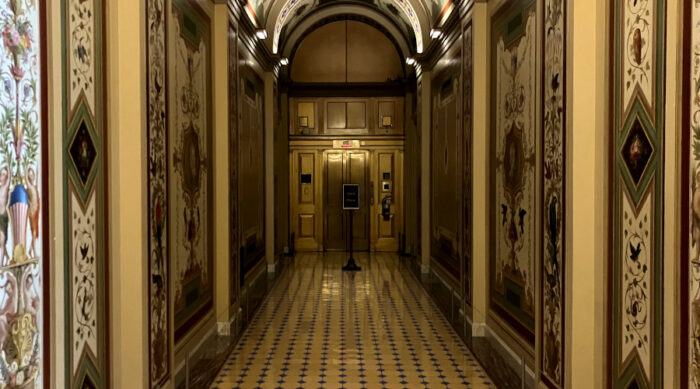
Therefore it won’t come as a surprise that, when the location of the first elevator in the Capitol was pointed out to me during a recent tour, I had to look into its history.
The first elevators were invented during the Civil War era, so it follows that there was a push to add one of these new devices into the Capitol not long thereafter–– in 1872, to be exact. On December 10 of that year, Senator Frederick Frelinghuysen of New Jersey introduced a resolution requesting that the Committee on Public Buildings and Grounds look into the possibility of adding an elevator to the Capitol.
Just three days later, Senator Justin Smith Morrill of Vermont introduced a bill to install an elevator. His argument was two-fold: it would reduce the need for men to carry items up in the Capitol by six, and would also help move Senators, “several of whom now found great difficulty in ascending the stairs,” as the Washington Evening Star reported later that day. The bill passed the Senate easily, but was voted down in the House of Representatives. Nonetheless, the seed was planted, and in March of the following year, one of the lines in the District appropriations bill one for 10,000 dollars for a “Senate elevator.”
Two months later, the Star reported that Leonard Atwood of New York had been given the contract to install an elevator “of the screw pattern.”
Screw elevators were just that – elevators that rose and fell when a screw was turned. This meant that when an elevator lost power, it would simply stop – there was no possibility of it falling down.
Atwood listed himself variously as a ‘machinist’ or ‘engineer,’ but was also an inventor. He would have multiple patents to his name over his life, including a number related to elevators. In this case, however, it appears that he was installing one built according to other patents.
Work proceeded apace, and on May 31, 1873, the Memphis Daily Appeal published a long explanation of the work, including that the “work of removing the heavy masonry, arches and flooring in order to make room for it, is found to require unusual force and patience.” They added that the elevator was to be used first and foremost by “senators and members and the officers of the two houses” but would not be used by the general public. A bunker would be added to the elevator “for the purpose of conveying books, documents, and fuel to the several stories” and this do away with an ‘army’ of workers whose job was “carrying wood, coal, and other materials along the public passages and stairways to the inconvenience and annoyance of everybody having business at the capitol during the sittings of congress.”
The actual opening of the elevator seems to have passed with no further ceremony, at least none that was commented on at the time. There were, however, soon rumblings of discontent about the elevator, some of which we will look at next week.