
When we last looked at the saga of Tunnicliff’s Tavern, it had finally shut down–– after about 50 years of on-and-off operation as a beer garden/saloon. This was just a few years before D.C. officially went dry. For much of this time, the building remained vacant.
A location like this, on 9th and Pennsylvania SE, could not remain unused forever, and so some time late or just after the First World War, it was taken over by the Penn Oil Company. Not to be confused with the South Penn Oil Company, which would later become Pennzoil, this company was, in spite of its name, located in Rosslyn, Virginia, and was expanding throughout the area.
On June 5, 1919, a group of children playing outside the gas station set fire to a pile of trash. Fortunately, the fire station was then, as now, just down the street on 8th and showed up posthaste to extinguish the blaze, so that the event rated only a single paragraph on the thirtieth page of the next day’s Evening Star, rather than the front page it would have covered had the gas stored there gone up in flames.
Throughout the 1920s, the corner was a hotbed of auto-related activity. While the main business was that of selling gas, there were also a steady stream of cars for sale there, and, for a while, a Jerome Engelberg used the old Tunnicliff’s building to manufacture auto tops. It was also used by a mysterious outfit known as the National Scenic Company, who apparently were in the business of selling photographs and paintings, some of which were hung in the Ohio Soldiers and Sailor’s home, but otherwise did their best to hide their affairs from the prying eyes of, well, their potential customers.

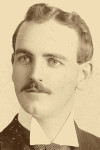
The old building was used for other purposes as well, as an ad run in May, 1930 showed. It stated that Adam A. Weschler & Son were going to auction off property stored in the old Tunnicliff’s building. (That’s Weschler himself, above.) Among the items listed were two cash registers, 75 “fine” booths, two “good” pianos, one “Eating Palace Complete” and a Merry-Go-Round. Sadly, there is no indication as to where or when these items had last been used.
The same year, Penn Oil was bought by Amoco, which was part of the Standard Oil Trust. Over the next years, they would sell oil branded as “Penn Oil.”
Later that decade, the old Tunnicliff’s building would be torn down. Pictures from that era show a sadly dilapidated structure. The current building was not built by Amoco until 1954, so it is unclear what the exact layout of the premises were in the intervening 20 years.
In 1998, BP and Amoco merged, first as BP Amoco, then later whittled the name down to just BP, and under that name they have operated at the corner of 9th and Pennsylvania for at least the last 20 years.
Where the sale of alcohol had proven to be an uncertain proposition, with no purveyor surviving for more than 20 years, the sale of gas appears to have gone on, unabated, for over 100 years.