

When taking visitors around the Capitol, one of the bigger surprises is the summerhouse – a small brick structure just northwest of the main building, with a fountain in the middle, seats around the side and a grotto visible through a grate on the east side. It is not at all what you expect to find there, but makes for a wonderful respite as you head down the hill and back to the city.
This small oasis was designed by the famous landscape architect Frederick Law Olmsted, as part of his redesign of the Capitol Grounds in the 1870s. While his main change to the Capitol was adding a marble terrace to replace the dirt that had previously surrounded three sides of the building, landscaping the rest of the grounds with lamps, trees and curved walkways gave the whole area a bucolic setting.
Questions about how the Library of Congress, then located in the center of the west front of the Capitol, would be expanded slowed the building of the terrace. It was not until the late 1880s that this work was completed. The summerhouse, an octagonal brick structure, was by then long-completed. It was built with a fountain in the center and came equipped with some means for conveying water to those in need of refreshment available. Whether those means were cups or ladles is no longer known.
Olmsted had wanted to complete the symmetry of his project by building a second summer house due south of the first one. In a letter to the Architect of the Capitol written in 1881, he outlined the work he wished to do in the 1882/3 building season. On the list is the entry “Summer house on the south side” with a price tag of $3,000. While this represented only about 3% of the total that he requisitioned, it was deemed too much – the entry is carefully deleted by means of a simple stroke of a pen. It is unknown who made this deletion.
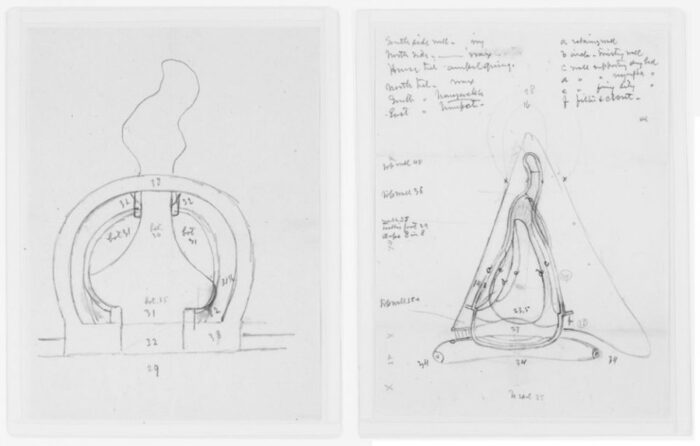
What is unfortunate is that it looks like Olmsted had come up with a really interesting plan. While the location would mirror that of the north summer house, the actual structure would be quite different. Instead of the octagonal shape, this one was to be a triangle, with walkways around the perimeter. At its center would be a pond that would appear to be fed by a spring. The walls surrounding the pond would then be covered with plants, chiefly ivy.
Most importantly to Olmsted would be that it did not take away from the Capitol itself, his plans were to be “subsidiary to the central structure.” Which, one supposes, is exactly what is done today with the triangle filled with grass and trees that is located in the spot where Olmsted had originally foreseen his second summerhouse.
Olmsted retired just a few years after the terraces he had planned for the Capitol were completed, and would die in 1903. While his sons continued his work, there clearly was no further interest in bringing back this final piece of his vision for the Capitol grounds.