
Last week, we looked at the Senate Hotel and its generally quiet existence, catering to young men who would stay there while working for the government. Occasionally, however, it would host shorter-term guests in town on business.
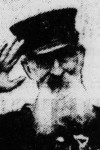
For instance, in 1926 Robert Henry L. Livingston a.k.a. Matt Greene, came to town to try to get a pension that he believed he was owed due to his service during the Mexican-American War, the Civil War, and the First World War. Livingston (that’s him at left) claimed to be 106 years old and changed his name (and his birthdate) in order to fight in all these conflicts. Due to these frequent changes, the pension office was wholly unable to verify any of his service. Thus, he embarked on a trip to Washington to sort it all out.
He was met by a Helen Craven from Traveler’s Aid Society, and taken to the Senate Hotel. Here, he was pleased to talk to a reporter from the Washington Evening Star. The story published later that day included this remarkable paragraph:
He stated he enlisted under Gen. Taylor for the Mexican campaign of ‘46 against Santa Anna; was with Commodore Perry when he “opened the gates of Japan” in ‘52; served under Gen. Scott in ‘56 against Mexico; was with Custer in his famous campaigns against the Indians; fought under Col. Theodore Roosevelt in the Spanish-American War and, finally, under Gen. Pershing in the World War.
After this interview, this 19th Century Zelig gathered up “his yellowed documents” and was taken to the Pension office – and disappeared from the public record again.
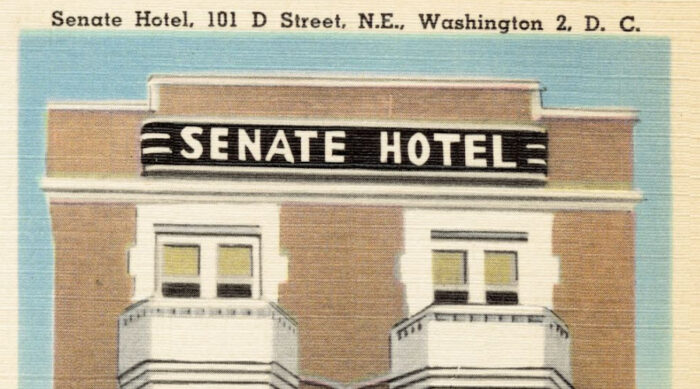
Four years after that, owner Guy McCord’s wife Grace McCord would find him lifeless in an armchair in their room at the hotel. Nothing that the ambulance crew that arrived shortly thereafter from Casualty Hospital did could revive him. Mrs. McCord would thereafter move to Florida, but the hotel continued to operate even after her departure.
During the Second World War, the Sino-Korean People’s League had their offices in the hotel. From there, they attempted convince the United States and Great Britain to “give Korea moral, political and financial help so it [could] become a ‘more effective factor to the United Nations’ war efforts in the Pacific.’”
The hotel seems to have gone downhill after this. There are frequent mentions of robberies of the establishment and of its being the target of robbers, whether of money left in rooms or, more brazenly, simply by pointing a gun at the desk clerks and demanding the contents of the cash drawer.
Mrs. McCord died in 1955, and the hotel would not long outlive her. Its demise was as quiet as its start; no articles at the time bemoaned the disappearance of another Capitol Hill institution. In 1966, a restaurant named “Nick and Dottie’s” opened at the same site, but they did not have the same staying power as the Monocle, which had opened a few years earlier just down the block. Eventually, Nick and Dottie’s closed and the Senate Hotel’s building was knocked down to make way for a parking lot.