

Last week, we looked at the Nacotchanks, who lived on the land that would later become the District of Columbia. Today, we look more closely at where, exactly, they were located.
In the Captain John Smith map of Virginia., the Nacotchtank are shown to be near what is Joint Base Anacostia-Bolling today, but otherwise there is no detail given. It would not be until the late 19th century that an attempt to formalize the knowledge of those who had lived here before was made. In 1889, the Anthropological Society of Washington put together a symposium on “The Aborigines of the District of Columbia and the Lower Potomac,” the proceedings of which were published in July, 1889 in their journal American Anthropologist.
The first lecture is about the geological history of the D.C. area. While it posits that there were people living here during the last ice age, it says nothing about any direct evidence for this statement.
The second paper is all about evidence in the guise of paleolithic tools found around the D.C. area. And there are many of them, as the images published with the article attest. Unfortunately, the author, Thomas Wilson, does not say where, exactly, these stone tools were found. This may, in fact, be irrelevant, as the tools were found partially on the surface, partially nestled deep into river gravels, neither of which give the stratigraphic context that would allow real conclusions to be drawn from the evidence. We have to settle for Wilson’s statement: “[The implements found] are part of the res gestae and must be accepted as evidence in the case, tending, at least, to establish the existence of a paleolithic period in the District of Columbia.” [emphasis in the original]
It is the next speaker, Samuel Proudfit, who finally begins to show evidence of Native Americans on Capitol Hill. (You can see him in the photo above) He begins with a map of the District showing evidence of habitation. Almost all of it is on the eastern banks of the Potomac and Anacostia Rivers, from across from Alexandria all the way up to where the Anacostia crosses into Maryland. A 1957 article by Howard MacCord of the Army Corps of Engineers argues that “the Nacotchtanks and their pottery-using predecessors favored the eastern side of the Anacostia River, probably because of the wide, sandy terrace found there as opposed to the high bluffs found along most of the western side.”
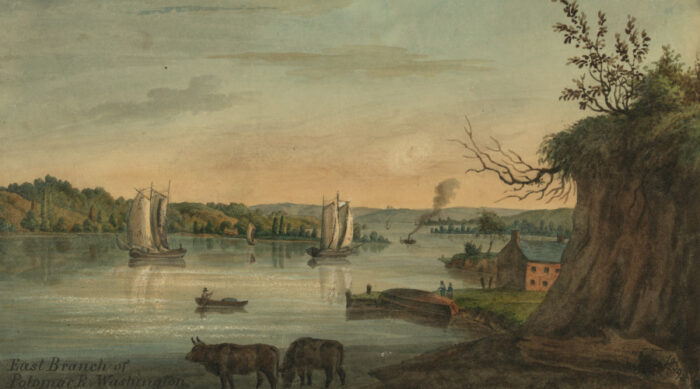
On the other side, only two sites are mentioned by Proudfit, one in what is the Arboretum, the other “the Carroll place in Washington, north of Garfield Park and between First and Second streets S.E.”
He also writes about the abundance of worked stone that has been found in these sites, stones that were worked in different manners out of a large variety of materials. Most of these are similar to implements found at other sites across the region. Proudfit continues:
One implement, however, I deem worthy of special mention – a long thin blade of quartzite, pointed at each end and sharpened along the edges. This type, frequent at Nacotchtanke, is very rarely found on the other village sites of the District. Professor Mason has aptly named it the “shad knife,” and its form seems to warrant the use implied by the appellation.
Sadly, nobody seems to have thought to include an image of this unique tool in the printed copy of the talk.
Next week: More on the Carroll place site.