
 The last two weeks, I have looked at two aspects of the LGBT history of Capitol Hill, this week I want to look at a place close to my heart: The Furies House.
When my wife and I bought our house on Capitol Hill, I was a computer programmer, so the obvious thing for me to do was to plug in the address of our new domicile into Google. And I discovered that the house had, for a short while in the early 1970s, been used as a headquarters for the Furies, a group of radical separatist Lesbians.
Intrigued by this, and finding myself looking for something to do that would challenge me intellectually when I became a stay-at-home-dad, I began researching the house’s history, a project that eventually led to my writing a whole book about it, and thereby learning enough local and D.C. history to launch me in a completely new direction.
But that’s not what I came to write about. I want to talk about the Furies, who collectively, and separately, had an enormous impact on Lesbian thinking over the last almost 50 years. The Furies came together out of frustration. They had all been involved in some aspect of the civil rights movements, but had found themselves marginalized even in these endeavors due to their sexuality. They had thus come to the conclusion that they would be better off on their own, that they would create a society entirely separate from the male-dominated one that they lived in.
Their first decision was to create a collective to discuss these goals, and write a monthly newspaper to promote them. In the first issue, Ginny Berson described themselves:
We are a collective of twelve lesbians living and working in Washington, DC. We are rural and urban; from the Southwest, Midwest, South and Northeast. Our ages range from 18 to 28. We are high school drop-outs and Ph.D. candidates. We are lower class, middle and upper-middle class. We are white. Some of us have been lesbians for twelve years, others for ten months. We are committed to ending all oppressions by attacking their roots—male supremacy.
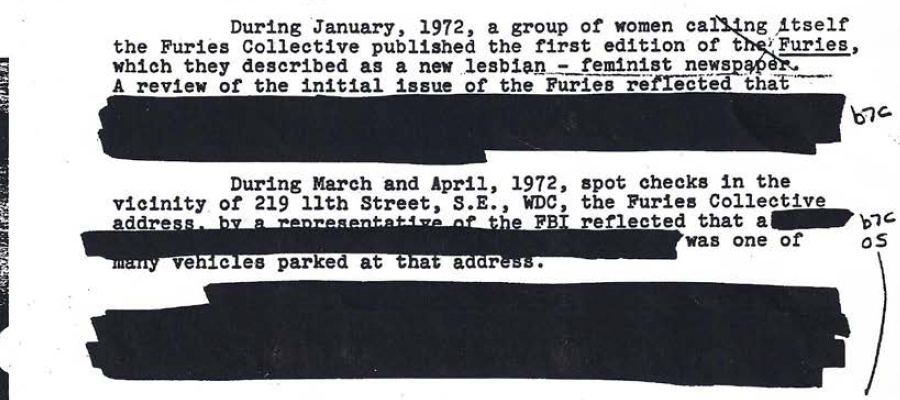
The Furies even caught the attention of the FBI, this heavily redacted detail of a page from their file indicates that some members’s car was spotted parked in front of the Furies house.
The Furies were Ginny Berson, Joan Biren, Rita Mae Brown, Charlotte Bunch, Sharon Deevey, Helaine Harris, Susan Hathaway, Nancy Myron, Tasha Dellinger Peterson, Coletta Reid, Lee Schwing, Jennifer Woodul, and they lived in three houses across Capitol Hill, with the house on 11th Street as the nerve center, and it was in the basement thereof that the newspaper, also named The Furies, was laid out and collated. The first issue came out in January 1972.
Sadly, the collective as such did not last long – by the summer of 1972, internal dissension had broken it apart. Nonetheless, the newspaper managed to outlast the collective by a year, and in the ten issues that were published, the group managed to explore many aspects of Lesbian life, and even soften their earlier insistence on radical separatism.
In the end, the Furies went their separate ways, with Brown becoming a well-known writer of mysteries, Biren (pictured) making films, Bunch becoming a professor at Rutgers, while Berson worked in radio.
In 2016, the Furies house was added to the National Registry of Historic Places.