
 In trying to find a more soothing topic to write about after the rather dour stories from the last two weeks, I came across a story that was… well, bucolic.
I originally stumbled across an article in the Washington Evening Star of May 26, 1856 that described a new painting showing the city of Washington from a vantage point on the other side of the Potomac:
It portrays the famous view that meets the eye when, standing on “Shuter’s Hill,” west of Alexandria, we look down up on the level fields spreading northeast towards the Potomac, beyond which the city of Washington skirts the horizon in one unbroken line, its dim dwellings marked at intervals by its various public buildings, that are plainly distinguishable.
Particularly intriguing was that it mentioned “the Navy Yard with its large ship houses, standing out in bold relief, giving great interest to the view,” but the only evidence as to which painting this was was the name of the artist: “McLeod.” Further research indicated that this was William MacLeod (pictured). Born in 1811 in Alexandria, he traveled to his parents’ country of origin, where he studied medicine and art at the University of Glasgow. After completing his studies, MacLeod returned to the United States, which he traveled widely. His first exhibit was in 1843, in Philadelphia, and he had soon become well-known for his landscape paintings. It appears that this did not fully pay the bills, as his obituary indicates that he continued to work “in the government service” in this time.
In 1873, he changed gears, becoming the first curator of the Corcoran Gallery of Art. Over the next 16 years, he not only redefined what it meant to be a curator, but left behind a series of journals that are today available to the public, and allow one to follow in his footsteps. When he died in 1892, he was buried in Congressional Cemetery. His wife Catherine would be buried next to him 13 years later.
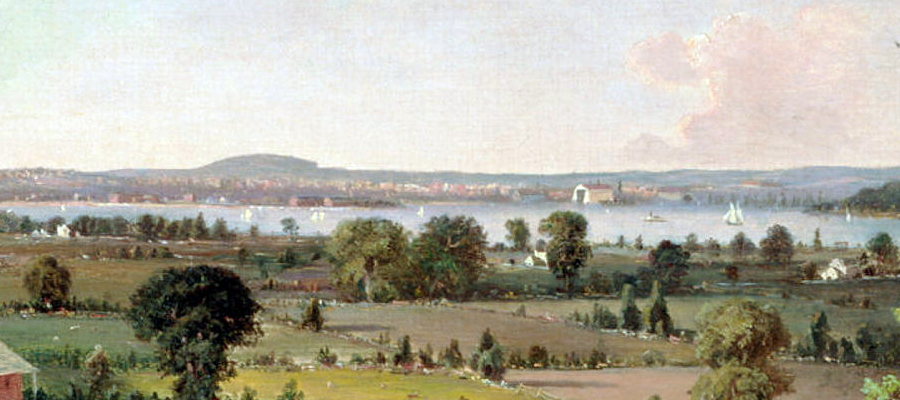
Detail of MacLeod’s painting, showing the two large ship buildings of the Navy Yard as well as other waterfront establishments. (whitehousehistory.org)
As to MacLeod’s painting, it shows not only an expansive view of the city of Washington, but also included a painter in the foreground—possibly MacLeod himself. The view it shows can still be seen today by going to the George Washington Masonic Memorial in Alexandria. The painting is properly known as “View of the City of Washington from the Virginia Shore,” and the Star had said that it would “be upon exhibition but for a few days, when it will go to Alexandria, where an appreciative commendation and liberal purchaser doubtless await it.”
Who, exactly, that “liberal purchaser” was is uncertain. However, it was eventually owned by Richard Mellon Scaife, who gave it to the White House. It now hangs in the Roosevelt Room in the West Wing, just across the hall from the Oval Office.