
As usual, my President’s Day post is a rerun. In the past, I have either given an overview of presidents on the Hill or simply shilled for the Library of Congress open house, which is happening again on its accustomed day this year. Instead, I want to look way back to one of my first columns, whose pictures have gotten lost in one of our migrations. It has at least a tenuous connection with Abraham Lincoln, so will have to do for today.
Lincoln United States Army General Hospital was built in 1861 on a rubble strewn field one mile east of the Capitol. The area on which it was built had been originally destined by Pierre L’Enfant to house a mile marker, from which all distances to and from Washington would be measured. Although the land was taken over by the federal government, nothing was done with it (nor was much built nearby) and so the reservation became a dumping ground.
When the Civil War erupted, there was an immediate need for hospital beds, and while those were first created in previously constructed buildings, the demand became so great that hospitals were built on any open ground. The government-owned reservation near the Capitol was thus a prime contender.
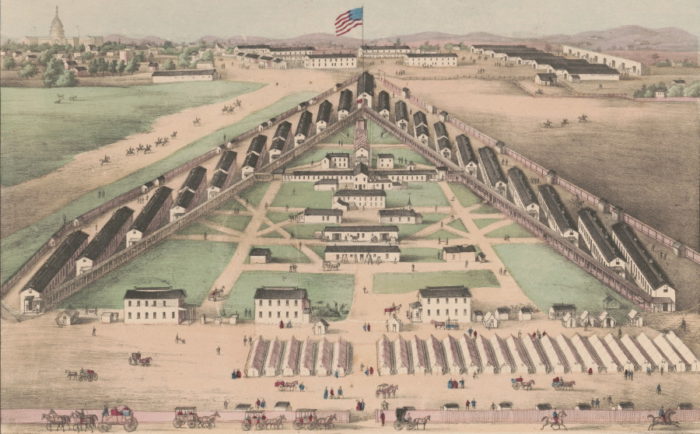
Bird’s Eye View of Lincoln United States General Hospital. Contemporary print. (from LOC)
The hospital was built of canvas-covered logs, and was considered a model hospital—and a vast improvement over the temporary hospitals built previously around the city in churches and other public buildings.
Lincoln Hospital had 2,575 beds, and was thereby the largest hospital in Washington.
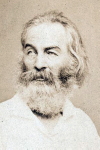
Walt Whitman [pictured], who was a frequent visitor, described Lincoln Hospital in an article printed in the New York Times of December 11, 1864, “[Carver Hospital] has more inmates than an ordinary country town. The same with Lincoln Hospital, east of the Capitol. … A wanderer like me about Washington, pauses on some high land which commands the sweep of the city…and has his eyes attracted by these white clusters of barracks in almost every direction.”
Although Lincoln often visited the hospitals around the city, there is no evidence indicating that he visited this hospital. However, a doctor assigned to Lincoln hospital was one of the first to offer aid to the President after the attack by John Wilkes Booth.
Lincoln Hospital is also where the first soldier to be buried in Arlington Cemetery passed away. William Henry Christman was admitted to Lincoln Hospital with a case of measles on May 1, 1864, died on the 11th and was buried in Arlington on May 13 of that year.
A few months later, the hospital was involved in the aftermath of the one attack on Washington itself during the war: The Battle of Fort Stevens. Both Union and Confederate soldiers were treated there in the fight’s aftermath.
After the Civil War, the hospital was torn down, but its name was passed on to the ground on which it had been built, first as Lincoln Square, later as Lincoln Park.