
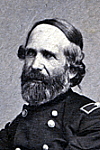
 In today’s post, we return to the Civil War and to a unit that was stationed on Capitol Hill on and off throughout the conflict. Over the next few weeks, we will look at what happened with the land on which they were stationed.
With the outbreak of the Civil War, regiments were raised all across the Union and sent south. A large number ended up in Washington, either to protect the city or to assist in the fighting from here. One regiment that spent a fair bit of time in the capital was the 50th New York Volunteers. Raised originally in the Southern Tier of New York as an infantry unit in September 1861, they were converted into an Engineer regiment after having arrived in D.C.
Their first task was to organize a place where they could live. They were given a piece of land just east of the Navy Yard for this purpose. It was hardly a nice area: an 1857 map shows only a few scattered houses on what was not soggy bottomland lining the Anacostia.
Nonetheless, this became home for the 50th, first through the winter of 1861/2, and for parts of the next four years. Sometimes the whole regiment would decamp; more often, a subset thereof, as companies of the unit were often detailed to other armies.
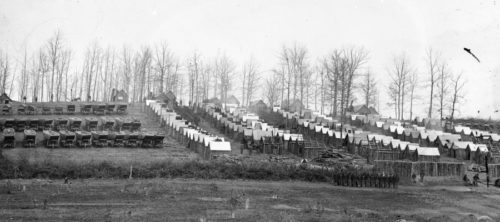
Camp of the 50th Engineers along the Rappahannock River (LOC)
At various times, soldiers of the units would send in reports to their hometown newspapers, giving a sense of the times. For instance, less than ten days after the Battle of Gettysburg —where the unit had been responsible for building bridges to get soldiers there but had not actually been involved in the fighting— a soldier wrote of a terrific rainstorm that lashed the camp:
The great event of the week here has however been the gale of Sunday the 12th inst. The forenoon had been oppressively hot, and all nature sweltering beneath the burning rays of the sun. But during the afternoon a heavy, black cloud slowly arose in the western horizon and gradually overspread the sky. Rain soon began to fall in torrents and the wind which had been idly fanning us from the east veered round to the south, increasing to a gale which filled every one with apprehension for his frail habitation. The flapping of canvass resembled the close discharge of fire arms. Officers and men freely exposed themselves to the pouring rain, more securely fastening their guys and stays to avert the catastrophe, but all in vain. At four o’clock a single blast from the South carried everything before it. Bunks, blankets, beds, sheets, and pillars, knapsacks, haversacks, canteens, shoes, sacks, coats, pants and sick men were piled together in – to all but the animal portion – inextricable confusion. The rain came down, not in drops or streams, but in sheets and pailfuls, upon the luckless ones thus rudely deprived of shelter. A single bonnet careering through the air told the story of one fair sufferer, the wife of an officer who had joined him a few days previously. Every tent in connection with the hospital was blown down, and those of nearly all of the officers. There were fifteen sick in the hospital, none however unable to walk. Fortunately a house stood but a few rods distant which offered ample heat and shelter. The inhabitants, soldiers families, kindly furnished supper, and it is to their kindness that our patients owe much for their preservation from the evils which would naturally result from the drenching. Mr. Newton, Mrs. Riley, & the two Mrs. Howard will ever be kindly remembered in connection with the gale of July 12th.
D.C. newspapers were mainly mum on the 50th, though a number of times it was mentioned that drowned men had washed up near the camp. However, after the war, an ad ran in the Washington Evening Star that gave a flavor of the place. It was an advertisement that ran over the name of Daniel. H. Rucker (pic) and was titled “Sale of Government Buildings.” In it it listed the leftover buildings on the site, consisting of two barracks of 24×98 feet, a commissary building, three offices and a guard house. The winning bidder was requested to have them removed by 15 days after the sales. The Star reported six days after the sale that buildings were sold for $959, and, presumably, some ten days later every sign of this encampment had been removed.