
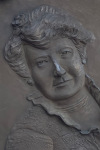
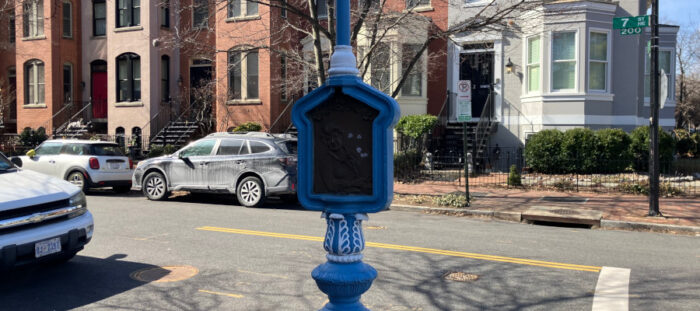
We at The Hill is Home are big fans of the police call box art that has proliferated across the Hill, both officially and unofficially. It is always a pleasure to notice new ones – even if they have been around for a while.
In this case, it is especially fun because it gives us the opportunity to talk about Alice Lee Moque, who truly deserves to be written about.
Alice Lee Hornor was born on October 20, 1861 (or maybe 18963 or 1865; sources vary) in New Orleans. Her father was a lawyer and abolitionist, he moved the family first to Philadelphia and then to Washington some time after the Civil War.
Alice married Walter Comonfort Snelling in 1879. They had three sons, one of whom became a chemist who was referred to by Hank Hill of King of the Hill as the “father of modern propane.”
While Alice was still a school girl when she married, she did not neglect her education, studying law and medicine at the university level. She also became interested in the chemistry and art of photography, publishing articles on that subject in various magazines. An 1890 article has the following splendid advice:
There are few better subjects than cows with which to construct your first picture, for they will not get camera-struck, or become the awkward wooden specimens our poor humanity if metamorphosed into the instant the lens is pointed.
Walter Snelling died in 1893. This did not slow Alice Lee down. In between becoming an author and a health activist, she married her second husband, John Oliver Moqué (and yes, that accent aigu over the e was very important to her) The marriage took place less than a year after her first husband’s passing. Together, they had one daughter, Voleta Alice Moqué, although she was not born until 1903.
In the meantime, Alice became ever more active as a writer, publishing the novel The Body Master’s Daughter in 1887. She was also interested in health education, helping to found the National Congress of Mothers, who were interested in ensuring that all mothers had access to all the information they needed to keep their children as healthy as possible. In part of this work, she became the first woman to address the American Medical Association.
Unsurprisingly, she was also interested in women’s suffrage, becoming the press representative of the National American Woman Suffrage Association. She had articles on the subject published in numerous magazines and newspapers across the country.
This was not enough for the indefatigable Mrs Moqué, as she used her considerable skills to support the United States in their fight against the Spanish in 1898. While she could only the troops from the sidelines with patriotic poetry and speeches urging them on, she felt that women could and should fight alongside men.
But her real life’s thrill was traveling. More on that next week!