

Many years ago. when I wrote my chapter on Abraham Lincoln’s time on Capitol Hill in the late 1840s, I mentioned Mrs. Sprigg, his landlady, in only one short paragraph. I simply did not know more about her, including what her first name was. To my credit, at least I spelled her last name right ––there is no ‘s’ at the end–– but that’s pretty much the only thing I got right. So, 15 year later, here is her story.
Ann G. Thornton was born about 1800 in Virginia. Nothing is known of her parentage or her youth. In fact, the first date recorded is her wedding: November 5, 1818. The groom was Benjamin Sprigg, born about 1780, most likely in Maryland. Little is known of his family, as well, though there was a fairly famous Sprigg family in Maryland at the time, including one Samuel Sprigg, who would become governor of that state the year after Ann and Benjamin’s wedding.
Benjamin Sprigg was a clerk in the House of Representatives at the time, and also owned a number of properties on and around the Hill. Earlier that year, his house on Greenleaf Point had burned, so it is not clear where he and his new bride lived.
Sprigg was an enslaver, as the 1820 census makes clear. His household at the time consisted of 15 people, 8 of whom were enslaved. There was only one white male listed as living there ––that would be Sprigg himself. Ann Sprigg was one of two “Free White Persons – Females – 16 thru 25” but is otherwise not listed.
The following two years would have Ann giving birth to two daughters, both of whom would die within 18 days of one another in 1822. At this time, the young family lived on First Street SE, between C and D Streets, so right where the Cannon House office building is today.
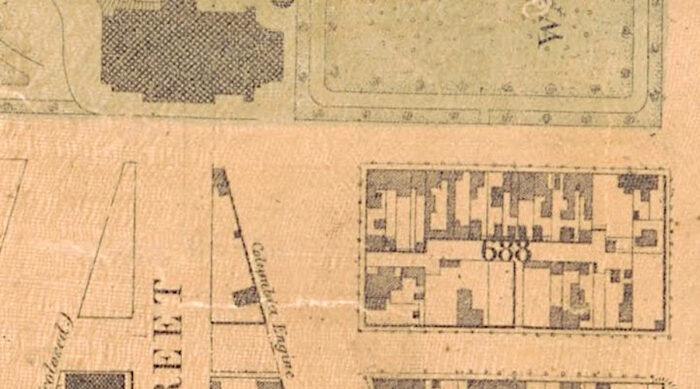
Over the next 12 years, Ann would have a further six children, one of whom died at age four. Benjamin Sprigg would continue his work at the House of Representatives and would also be a member of the Columbia Fire Company, possibly to ensure that no further of his houses would succumb to flames.
Benjamin Sprigg died young, at about age 53, on September 29, 1833. It left Ann Sprigg not only a widow with five young children, but also pregnant: Her son, named Benjamin after his late father, was born late in 1833.The widow Sprigg was forced to fend for herself, and the best way to do that was to become a landlady. On January 7, 1834, an ad ran in the National Intelligencer:
Mrs. Benjamin Sprigg is prepared to accommodate five Members of Congress or transient visitors with Board at her residence on 1st street east near the Capitol. Her terms will be very moderate and the accommodation, she flatters herself, satisfactory.
While far from an ideal existence, it at least looked as if life would be a bit less stressful for Ann Sprigg from then on. As we will learn next week, that would not be the case.