
On February 24, 1965, less than a month after Lyndon Johnson had taken the oath of office on the East Front of the Capitol, workmen began building another inauguration stage.
It was not nearly as elaborate as the one used in January, which had required over 100 workers and four months to complete. The work this time took three men less than a week to complete. However, it was historically accurate vis-à-vis the platform used 100 years earlier by President Lincoln in his second inauguration.
The reason for the work was to celebrate that momentous centenary, and the construction was just a small part of the whole effort. The entire procedure was organized by Dore Schary, who had a long career as a playwright, director and producer. In particular, he had recently produced a play based on the life of Franklin Roosevelt; this had given him insight into the intricacies of historical reenactments.
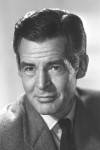
For the part of Abraham Lincoln, Schary chose Robert Ryan, whose career as an actor stretched back to before the Second World War, during which he had served in the Marines. He had starred in Bad Day at Black Rock, which had been produced by Schary, and then later played Abraham Lincoln in a TV movie called The Presidency: A Splendid Misery. (That’s him, above)
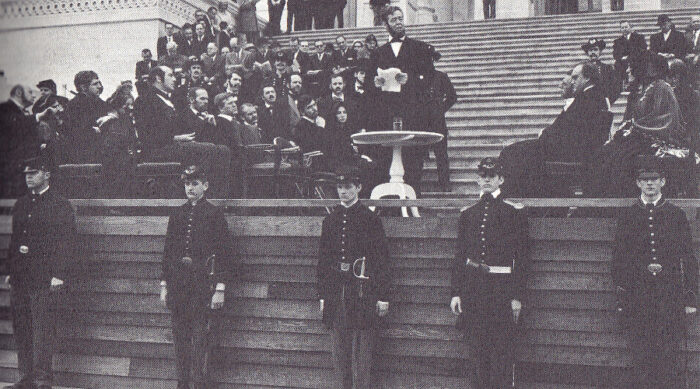
The part of Mary Lincoln was played by Yvonne LaChappelle. Other parts were played by members of Catholic University’s Speech and Drama Department. The reenactment was narrated by Adlai Stevenson, then US ambassador to the United Nations.
However, before the main feature, there was also a performance by the Marine Band, as well as a number of invocations, greetings and a speech by historian Bruce Catton. The audience could follow along with the aid of a small booklet that included the program, as well as a facsimile of Lincoln’s draft of the speech, as well as newspaper articles from before and after the original ceremony.
The ceremony began at noon on March 4, 1965, and went without a hitch. There is no indication that John Wilkes Booth’s brief cameo was part of the reenactment. The following day, the Washington Post printed a short article describing the scene, and quoted from Catton’s speech that “very poor progress was made” in the struggle for human freedom since Lincoln’s call for it in 1865.
They also pointed out that the majority of the audience were local schoolchildren, though the primary reason for the whole event ––and the majority of the $15,000 spent on it–– were the multiple film cameras that captured it from all angles, as there was to be a movie made of this ‘for showing in schools here and possibly overseas by the U.S. Information Agency.”
Whether this movie was ever made is unclear. Certainly none of the usual obvious places that a movie like this might be listed or even archived, show any trace of it. Fortunately, the US GPO, two years later, printed a sober hard-backed book entitled Ceremonies and Reenactments of the One Hundredth Anniversary of the Second Inauguration of Abraham Lincoln, 1865 – 1965. Included is a copy of the program handed out that day, as well as a letter from President Johnson, and numerous pictures of the day’s events. It remains the only tangible evidence of what must have been a fun experience for all involved.