
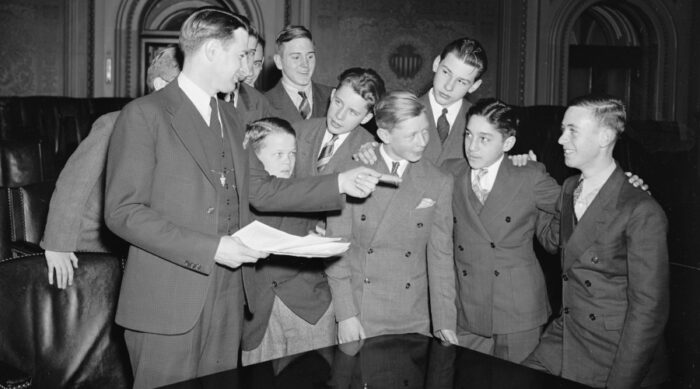
The pages that used to help keep the House of Representatives running are no more, having been abolished about 10 years ago due to the ever-increasing use of electronic messaging. For some 180 years before that, they were ubiquitous, making sure that the vast amounts of paperwork produced by Congress were delivered to the right place at the right time.
Sometimes pages, however, were more than simply well-dressed messengers. Some of them had duties far beyond their calendar age. And among this elite group, none stands quite as tall as Thaddeus Morrice.
Born on November 15, 1834, Morrice became a page in the House of Representatives before turning 10. He showed an aptitude for House procedure at an early age, and was soon a fixture at the Speaker’s desk, assisting that gentleman in running the operation. He first worked for Linn Boyd, after he was elected Speaker in late 1851. In Morrice’s obituary, written by the Washington correspondent of the St. Louis Democrat, his work was described:
Standing just at the Speaker’s elbow, with his arm leaning upon the desk and his chin resting upon his hand, which was between the Speaker and the audience – in that attitude of whispering to the Speaker the faithful Thaddeus has stood during many session of Congress[. …] It is said he knows more of parliamentary law than any man in America. And he knew every member of the House in all these Congresses – it was is his special business to know them. No speaker could get along without such an assistant, at first.
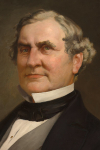
The need became especially acute when William Pennington (that’s him, above. Sadly, no picture of Morrice exists) was elected as Speaker in 1860. He was only the third freshman Representative to be selected for this honor, and it meant that he was entirely bereft of any knowledge of either the procedures or even the names of his colleagues. The St. Louis Democrat continues:
When Pennington was Speaker, a good portion of all the words he uttered were literally put into his ear by Thad. He did not know one quarter of the members even by sight, and was sadly deficient in Parliamentary law. When any member arose, he would say, “the gentleman from,” generally without the least idea what State he was to name, but so prompt was Thad. to give it, and so unobserved in doing so, that not one in a hundred who was not cognizant with the process would imagine but what Pennington knew all the members. And many and many a time the old man would commence the statement of a question, not knowing how he was to finish his sentence, which was furnished and finished by the youthful parliamentarian at his elbow.
The New York Mail, who called Pennington a “delightful old gentleman” summed up Morrice’s work in the following anecdote
Once, it is related, when young Morrice had prepared everything snugly for Pennington, outlined the order of business, prompted him completely, and left the course “straight as the crow flies,” so that a wayfaring man, though a fool, need not go astray, he said the speaker: “Now, go on.”
“Now, go on!” cried Pennington, promptly, to the House, at which there was huge laughter.
Even Schuyler Colfax, who is considered to have been one of the most successful in running the House, did not want to lose his services, and had him exempted from the draft. By this time, Morrice was no longer a page, having been promoted to Messenger to the Speaker in 1855.
Sadly, Morrice would not serve Colfax for very long, as he died March 15, 1864 of Typhus. He was buried in Mt. Olivet cemetery.
The job he had held would eventually be renamed Clerk at the Speaker’s Table, and, since 1927, Parliamentarian, a name that finally is worthy of the importance of the post.