

I have frequently looked at technology and invention, and how it was done or helped on the Hill. Recently, I realized that I had failed to mention one of the most famous moments in the history of invention: when Samuel Morse first sent a telegram from Capitol Hill to Baltimore. What I discovered in looking into this moment is that it had several antecedents, one of which I will look at today.
The early 1830s were an exciting time for telegraphs. The battery technology and understanding of electrical circuits had both improved to the point where it looked as if the next step would be the transmission of information across long distances using this new method.
One man who found himself swept up in this was Samuel F. B. Morse. Best known as a painter, he had been working on a painting in Washington when he received – altogether too late – the message that his wife was dying. In fact, transmission of this fact and the slowness of travel at the time meant that she was not only dead but buried by the time he arrived home.
On a subsequent trip to Europe, Morse became fascinated with the idea of using electrical signals to transmit information, and immediately set about researching the issues. In particular, he found the question of how to endcode the data to be worth studying, and came up with several overly-complicated systems before finally settling on what we call Morse code today.
But first, he had to convince people of this new technology, which required a visit to D.C. The Baltimore Commercial Transcript described Morse’s exhibition of February 14, 1838:
Mr. Morse, the inventor of the Electro Magnetic Telegraph, exhibited his machine in the Capitol to day, to the gratification of every one that saw the ingenuity of his invention. Nothing can be more wonderful that to witness the manner in which the most mysterious of all agents, is made to convey at a distance the information by means of characters. The Machinery is too complicated, for me to give you an idea of the way this invention works, and yet a short explanation from the inventor makes it at once simple ant intelligible to all.
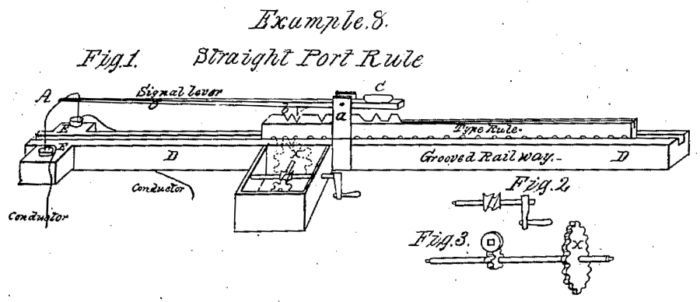
Mr. Morse exhibited two immense rolls of sheathed wire would round a steel bar, which on being subjected to the galvanic fluid, showed the bars to be highly magnetised, though the wire the fluid had passed through to them, was ten miles in length. This fully proved the practicability of applying this powerful agent on a large scale.
While the writer, despite sounding a bit incoherent, seems to have been won over (his talk of the magnetization of the steel bars shows that he did not really understand what was going on), the powers that be were not. Tom Standage, in his wonderful book The Victorian Internet writes that this was due to Morse’s setup, which had sending and receiving stations close together, and which had no way for those viewing the experiment to really get a sense of how this would work over a distance.
It did not help that this all took place in the recession that followed the Panic of 1837, and thus Morse went off to Europe to try his luck there.
He would return to the Capitol in due course. This is something I will look into in future columns.