
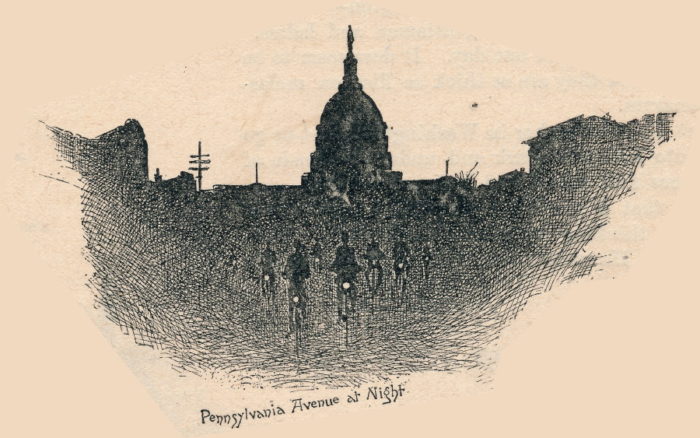
Ever since I found the image of the bicyclists riding on Pennsylvania Avenue with the Capitol in the background, I have been searching for just the moment to use it. This opportunity has never presented itself, so I had to go find it – in this case by searching for “Capitol Hill Bicycle” in the Library of Congress Chronicling America newspaper archives.
What I found was the story of a lot of accidents, many people who came to grief while biking down the Hill, either by hitting a curb or being run over by a Herdic. An example of the former can be found in the Evening Times of June 28, 1897:
Miss Irene Shipley, while riding her bicycle down Capitol Hill this forenoon, collided with the coping near the Peace Monument. She was thrown headlong to the roadway, and received a bad gash on her face. Friends remover her to her home, No. 314 G street.
There was also an active Capitol Hill Bicycle Club, one that was large and active enough to field a whist team.
But the most intriguing connection that saw was a small want ad in the February 23, 1919, issue of the Washington Evening Star: “BOY – Schoolboy, living near Capitol Hill; Must have bicycle; hour’s work daily; will not interfere with school. Apply Mr. Oliveri, 510 12th n.w., 2nd floor.”
A little research in the city directory of the day revealed that 510 12th contained a printer, a bookbinder – and the publisher of “The Bulletin.” The last was a single-sheet newspaper published twice a day and distributed around town, mainly to bars who would put it up in their window, presumably to attract customers.
Unsurprisingly, The Bulletin featured mainly sports scores, and their ability to collect and disseminate these facts quickly put them ahead of their competitors. It was presumably here where the “schoolboy” came in. A 1902 article in the Evening Star explained how it worked.
In the progressive steps of reporting the messenger of foot has been displaced by the lithe boy who can drive a bicycle from Capitol Hill to The Star building in a few minutes.
The article also mentioned that it was also possible for reporters to call into the Star and have “expert typewriters” take dictation over the phone.
What information our schoolboy was supposed to be carrying is sadly not mentioned in the ad, nor is it clear who “Mr. Oliveri” is. The ad may have been placed in time to get ready for baseball season, although the Washington team at the time played fairly far from Capitol Hill. Or maybe it was to send duckpin tournament results to the Bulletin.
All that really is left is the mental image of a “lithe boy” hurtling down Capitol Hill and along Pennsylvania Avenue towards 12th Street NW.