
 Last week, I looked at the strange case of David Atzerodt’s horse. Today, I will look at another aspect of the conspiracy, this time in what Lewis Powell (or Payne/Paine) was up to that evening – and even find a little more about that horse. I also attempt to correct an Urban Legend (or, more accurately, a small piece of historic lore) in spite of the fact that this story connects one of my favorite places – Congressional Cemetery – into the Lincoln Assassination story.
“Conspirator Lewis Powell (Paine) hid in a tomb [in Congressional Cemetery] after his attempt on the life of Secretary Seward. He was supposed to meet Booth, but got lost and spent three hungry, cold days in a marble vault.” – Ralph Gary, Following in Lincoln’s Footsteps: A Complete Annotated Reference to Hundreds of Historical Sites Visited by Abraham Lincoln, 2001.
Like David Atzerodt, Lewis Powell’s path after the fateful night of April 14, 1865 is uncertain at best. Unlike Atzerodt, Powell completed his mission, namely to attack William Seward, though fortunately he failed to kill the Secretary of State.
Upon fleeing Seward’s house, he found himself all alone: David Herold, who was supposed wait outside, then help Powell navigate the city, had disappeared on hearing the hue and cry coming from within. All that was left was his horse – or, more accurately, Atzerodt’s horse. For it was Powell that Atzerodt had given the horse he had been boarding at Fletcher’s stable. Powell mounted and was last seen making his slow way up 15th Street and turning onto Vermont Avenue.
Three days later, Powell reappears, at Mary Surratt’s boarding house – a noticeably poor choice in venues to appear. He was, of course, immediately arrested, and brought out to the Navy Yard before being taken to the Arsenal, trial, and hanging.

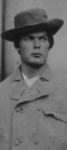
Lewis Powell, modeling the jacket that he had worn during the attack on William Henry Seward, lost later at Fort Bunker Hill. Photo by Alexander Gardner, and taken aboard the Saugus at the Washington Navy Yard. (LOC)
What had happened in the intervening days remains a matter of speculation. Known is only that a) his horse was found near Lincoln Hospital, and b) his coat was found near Fort Bunker Hill, north of Rhode Island Avenue and near Eastern Avenue.
Speculation of what he was doing is rife and historians can’t agree whether he spent the time in a tree, a cemetery, or simply wandering the streets. The combination of cemetery and Lincoln Hospital has made people suspect that it was Congressional Cemetery where he spent his time. However, there is no evidence making this anything but a guess.
During the course of his trial, no mention of the missing three days is made, other than to mention that his coat was found in Fort Bunker Hill. Instead, the prosecution spent its time making the connection between John Wilkes Booth and Powell and proving the latter had made the attack on Seward, while the defense rested on the twin pillars of Powell having taken care of wounded Union soldiers, and his being insane – neither of which seems to have swayed anyone in a meaningful way.
Sadly, it seems that Powell took this secret to the grave, and making it extremely unlikely that we will ever know for sure whether or not he spent the days between assassination and capture at Congressional Cemetery.