

Protests are a permanent feature at the Capitol – or were, at least, until the protest on January 6 turned into an insurrection. Pretty much any time you headed to the Capitol before then, there was some group or other agitating for or against some change or other.
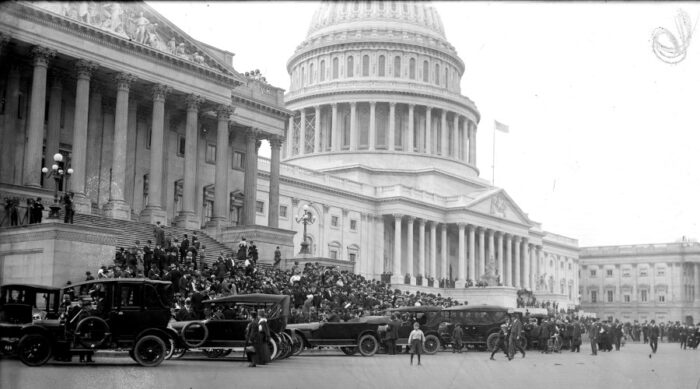
This has become so much part of our life that it is hard to imagine that it was ever different. Yet, 150 years ago, protests were not nearly the same thing they are today. It was a more genteel age, and differences of opinion were expressed via memorials – what we would call petitions today. But there must have been a first protest at the Capitol. What it was and how it occurred is probably impossible to determine at this late date, so we will look at one particular protest that was captured in the newspapers of the time.
It was 1871. Earlier that year, the pervasive chaos that was D.C. governance at the time came to a head. Having a city split into three separate units – Washington City, Washington County, and Georgetown – was becoming ever less viable. A new organization was called for, and so the D.C. Organic Act was passed early in the year, combining these three under a single governor, in this case Henry D. Cooke, who can be seen at left.
While this straightened out some of the political difficulties, it left the financial situation untouched, and so, later in the year, an improvement bill was introduced. It was to ensure that the federal city had the money it needed to make the improvements that were absolutely necessary for its continued existence.
As always with a bill of this nature, there was opposition, and so a grand protest was planned. It was led by William H. Philip and someone referred to only as “Gen” A. Grant, most likely Albert Grant, and large numbers of East Washington (what we could call Capitol Hill) residents were to appear, having been told that their presence would ensure that their section of the city would get a fair share of the monies distributed.
At the last minute, however, it became clear that the protest was to be entirely against the bill. The Evening Star described the scene:
The grand spontaneous mass meeting of citizens that was to have been held on Capitol Hill Monday night to protest against the improvement bill did not come off. Somebody had been at pains to erect a large stand, with ample accommodations for a crowd larger than could be accommodated within walls, but at the time appointed for the meeting less than a dozen were present, including the knights of the pencil.
In spite of the small turnout, Grant, who had to work alone, Philip having failed to appear, “went through the characteristic performance of calling the meeting to order, nominating a chairman, vice presidents and secretaries, and appointing committees, after the Bentonian and Philipian style of setting the ball in motion, ‘solitary and alone.’”
Clearly, a protest back then ran very differently than today, where we can expect a few speeches, maybe a song or two, signs and chanting. But no secretaries, chairmen or committees. And when we are allowed back onto the Capitol grounds, I doubt that those will make a comeback.
As to the improvement bill, it passed, and in spite of some efforts to block the sale of bonds, it began the explosion of civic improvements that radically changed D.C. in the 1870s.